

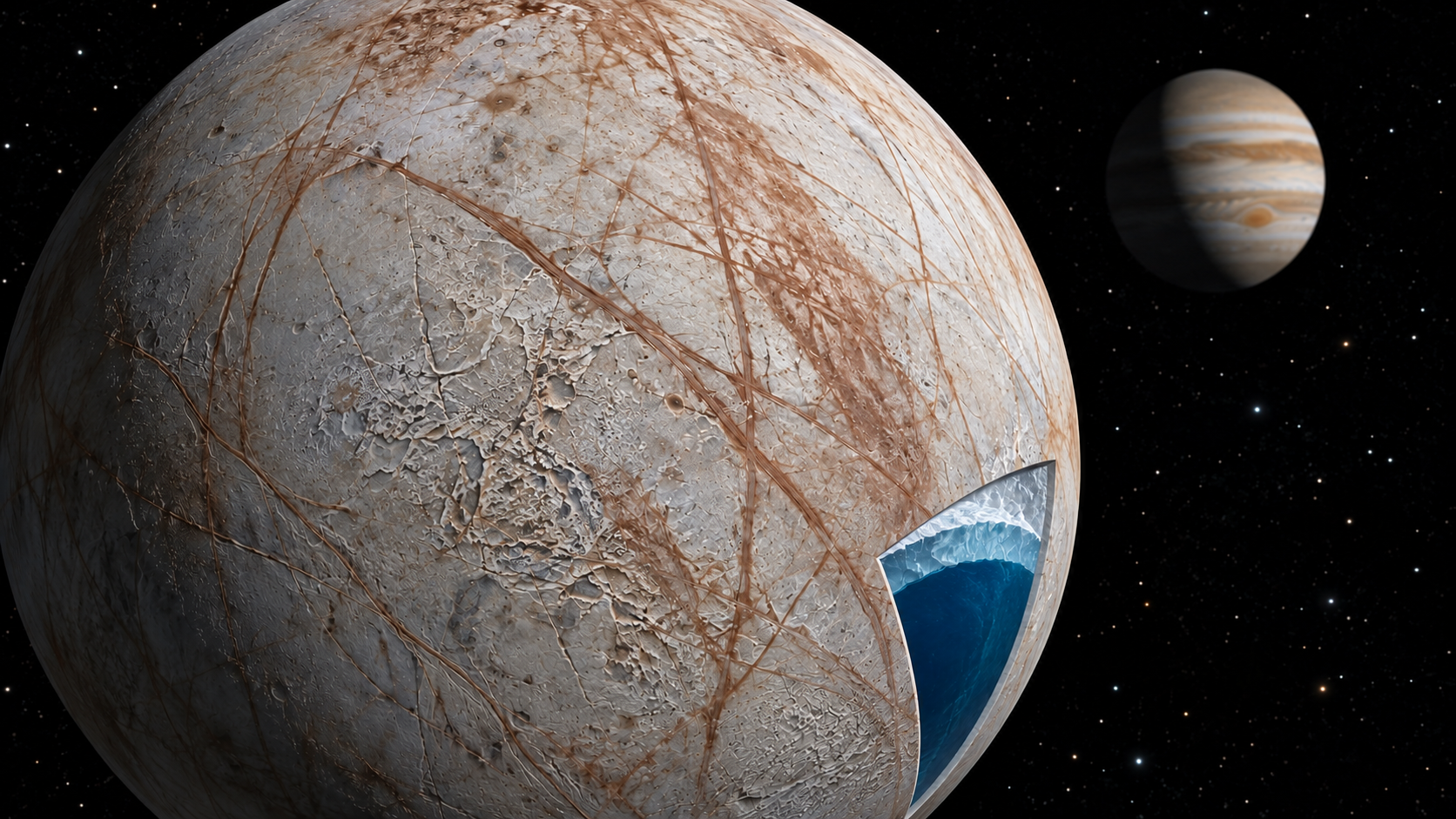
Maybe—but no one has found life on Europa. Scientists have strong evidence that this moon of Jupiter has an ocean beneath its icy surface. They want to learn whether that ocean has the conditions life would need. That question is one reason NASA sent the Europa Clipper spacecraft to investigate.
It is an exciting idea to share with a child: a world that looks frozen on the outside may hold an ocean deep below.
How can Europa have an ocean under ice?
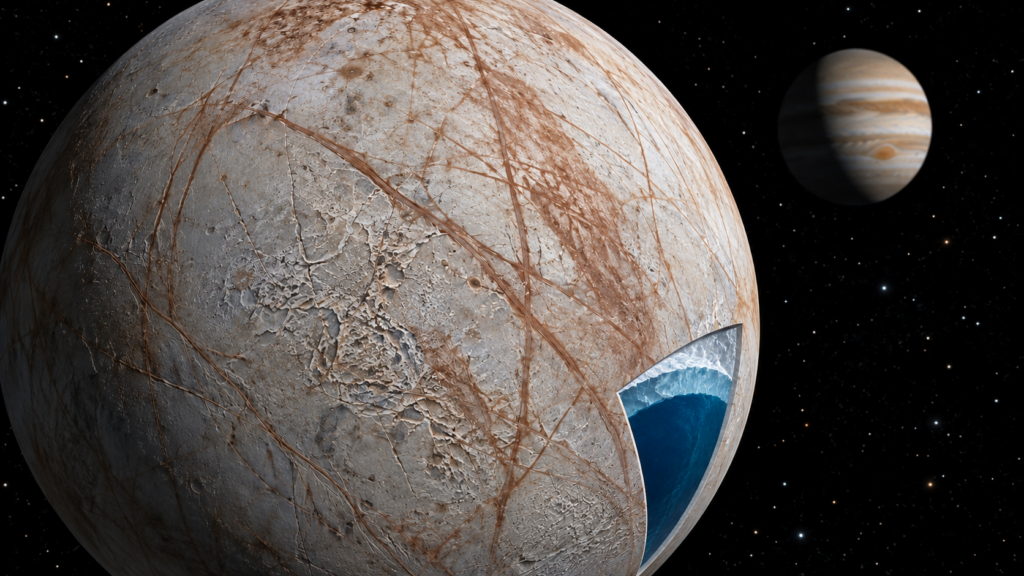
Europa is a moon that orbits Jupiter. Its surface is covered in ice, but evidence suggests liquid water lies underneath. Jupiter’s gravity continually pulls on Europa as it travels around the planet. That motion may help generate heat inside the moon, allowing water below the ice to remain liquid.
Imagine a frozen pond—but with an ocean beneath the ice instead of a shallow layer of water. Europa’s ocean is hidden, so scientists must study the moon from above to learn more about it.
Does water mean there is life?
No. Finding water does not mean finding living things. Life as we know it also needs useful chemicals and a source of energy. Scientists are investigating whether Europa has those ingredients and whether they could exist together in places where life might survive.
That is why Europa is so interesting. Its ocean makes it a promising place to look for conditions that could support life. It does not tell us that anything lives there. NASA describes this distinction in its Europa Clipper science goals.
What is Europa Clipper looking for?
Europa Clipper is traveling to Jupiter to make repeated close passes by Europa. Its instruments will study the icy shell, gather clues about the ocean below, examine materials on the surface, and look for signs of activity such as possible water vapor plumes.
The spacecraft’s main question is: Could places beneath Europa’s surface support life? It does not carry instruments designed to find living organisms. Even if its measurements show that Europa could be habitable, that would not prove life is there. NASA explains the mission’s limits in its Europa Clipper FAQ.
A simple Europa activity for kids
You can help a child picture Europa with a drawing:
- Draw a large circle for the moon.
- Add a thin, cracked outer layer and label it ice.
- Color a layer beneath it blue and label it possible ocean.
- Ask: “If you could send a robot to investigate one part of Europa, what would you want it to find out?”
Let your child invent a robot, then talk about the difference between a guess and evidence. Scientists have evidence for Europa’s hidden ocean. Whether it contains life remains an unanswered question.
Frequently asked questions
Has anyone found life on Europa?
No. Scientists have not found life on Europa.
Is Europa a planet?
No. Europa is one of Jupiter’s moons.
Will Europa Clipper tell us whether aliens live there?
Europa Clipper is designed to investigate whether Europa has conditions suitable for life. It is not a life detection mission.
Why study Europa if we cannot see its ocean?
Measurements of Europa’s ice, surface, gravity, and surrounding environment can give scientists clues about the ocean hidden below.
The answer for now: Life could exist beneath Europa’s ice, but we do not know. Exploring what its ocean is like is the next step toward answering that question.