
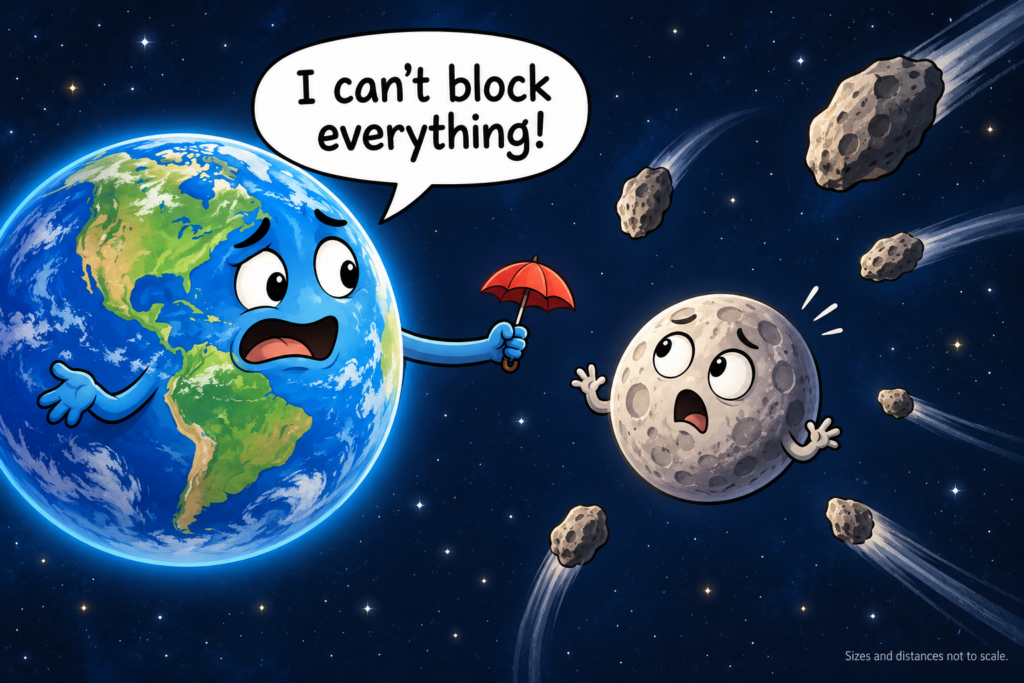
The Earth-facing side of the Moon has lots of craters because Earth blocks only a tiny part of the Moon’s sky. Space rocks can approach from many other directions and strike that side without coming anywhere near Earth. Those impacts have left craters that can remain visible for billions of years.
It’s a reasonable question: if Earth is sitting in front of one side of the Moon, shouldn’t it act like a giant shield?
Earth does block some incoming objects. But distance, direction, and a very long history of impacts explain why the Moon still gets hit.
Why Doesn’t Earth Shield the Moon?
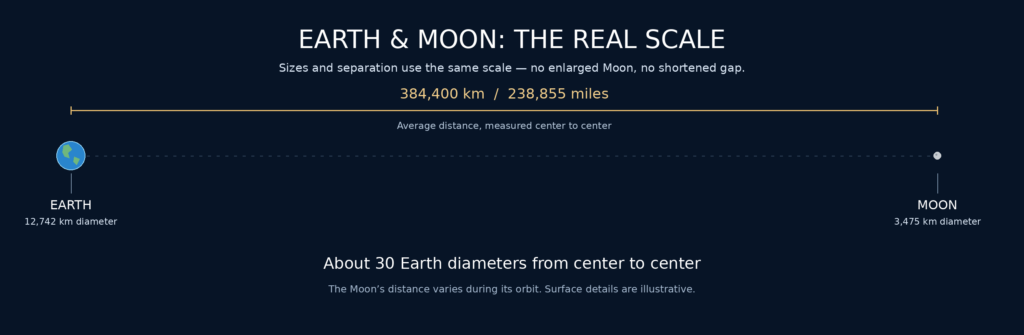
Earth is much larger than the Moon, but the two worlds are also far apart. The Moon orbits about 239,000 miles from Earth on average.
At that distance, Earth covers only a small patch of the lunar sky. From the Moon’s surface, there is plenty of open sky above and around it.
Imagine standing in a large field during a hailstorm with a tree far in front of you. That tree might stop a few hailstones coming from its direction, but hail can still reach you from above and from either side.
Earth provides a small shield in one direction. It doesn’t form a protective roof over the Moon.
Can Asteroids Hit the Side Facing Earth?
Yes. An asteroid doesn’t have to travel straight past Earth to reach the Moon’s near side.
The near side is an entire hemisphere—half of the Moon’s surface. Space rocks can strike it from many angles, following paths that completely miss Earth.
Think of shining a flashlight at a ball. You can illuminate the side facing you while holding the flashlight above, below, or beside your head. Likewise, an incoming rock can reach the Moon’s Earth-facing side from a range of directions.
Why Does the Same Side of the Moon Always Face Earth?
The Moon rotates once on its axis in the same amount of time that it takes to orbit Earth. This is called tidal locking.
As the Moon moves around Earth, it turns just enough to keep approximately the same face pointed toward us.
That doesn’t mean the Moon is standing still or that its near side is permanently sheltered. Tidal locking determines which side we see; it doesn’t prevent objects from striking that surface.
Why Are So Many Craters Still Visible?
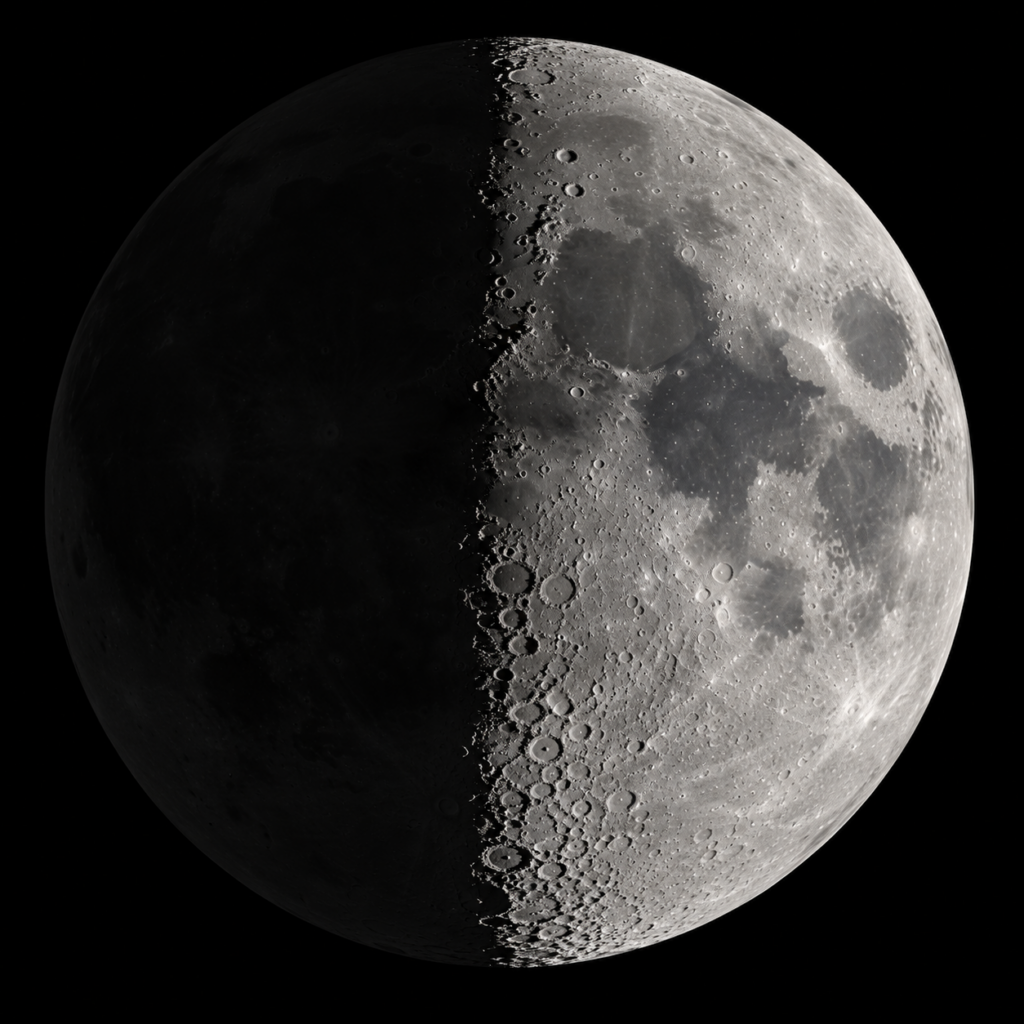
The Moon keeps a remarkably long record of impacts.
On Earth, rain, rivers, wind, moving ice, and geological activity gradually wear away or bury many impact craters. Earth’s atmosphere also causes many smaller incoming space rocks to break apart or burn up before reaching the ground.
The Moon has almost no atmosphere and no rain or flowing rivers. As a result:
- Small space rocks can reach the surface.
- Impacts leave craters with little weathering afterward.
- Many ancient craters remain visible for billions of years.
The craters you see are the accumulated marks of a long history, including periods early in the solar system when impacts were much more frequent.
Does the Far Side Have More Craters?
The Moon’s far side is generally more heavily cratered than the near side, but Earth’s shielding isn’t the main explanation.
Large areas of the near side were flooded by ancient lava flows. That lava covered older craters and formed the broad, dark plains we can see from Earth, called maria.
The far side has fewer of these large volcanic plains, so more of its ancient cratered terrain remains exposed.
Frequently Asked Questions
Does the Moon rotate?
Yes. The Moon rotates once during each orbit around Earth. That matching motion keeps approximately the same side facing us.
Is the Earth-facing side always dark?
No. Both the near side and the far side receive sunlight. “Far side” means the side facing away from Earth, not a side that is permanently dark.
Do space rocks still hit the Moon?
Yes. Impacts continue today, adding new marks to the Moon’s ancient surface.
Has Earth stopped every asteroid that could hit the near side?
No. Earth can intercept objects along certain paths, but most possible paths to the Moon’s near side pass clear of Earth.
Try This With Your Child
Hold a large ball to represent Earth and place a smaller ball several feet away to represent the Moon.
Look toward the larger ball from beside the smaller one. Notice how much space remains visible around “Earth.” An incoming rock could travel through that open space and hit “the Moon.”
Then ask: “Would Earth need to be much closer to block more of the sky?”
It’s a simple way to explore why even our large planet can provide only limited protection for its crater-covered neighbor.