
Wombats poop cubes because parts of their intestinal walls stretch differently. As the muscles squeeze and the waste dries, these differences help form flat sides and corners. The cubes take shape inside the intestine, before the wombat poops.
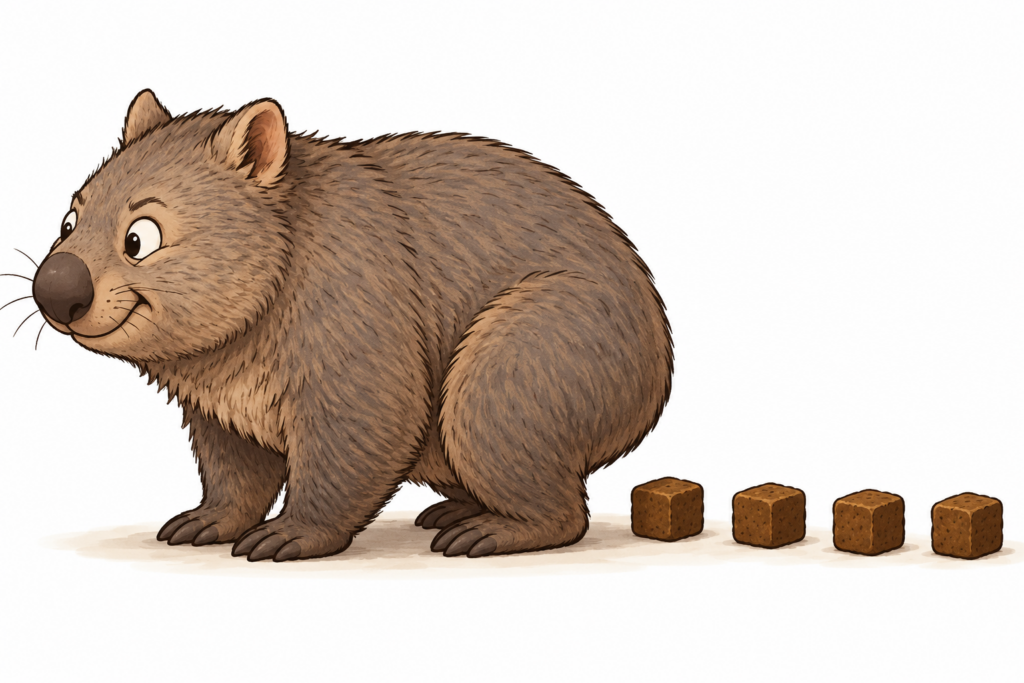
Yes, you read that correctly. Somewhere in Australia, a wombat is making something that looks a little like a tiny brown building block.
Nature has a strange sense of humor.
How Can a Soft Intestine Make a Cube?
Imagine trying to shape a cube inside a soft tube. It sounds like a tricky art project!
Researchers studying bare-nosed wombats found that their intestinal walls have areas with different stiffness. As those walls repeatedly contract, they shape the waste moving through them. Scientists used dissections, tissue testing, and mathematical models to investigate this unusual process. Their study identified differences in intestinal stiffness as a key to forming the corners.
Think of gently squeezing modeling clay with some fingers pressing more firmly than others. That comparison isn’t exactly how a wombat’s intestine works, but it helps explain how uneven pressure can change a shape.
The wombat doesn’t have to think about any of this. Its digestive system handles the construction work.
Does Cube-Shaped Poop Help Wombats?
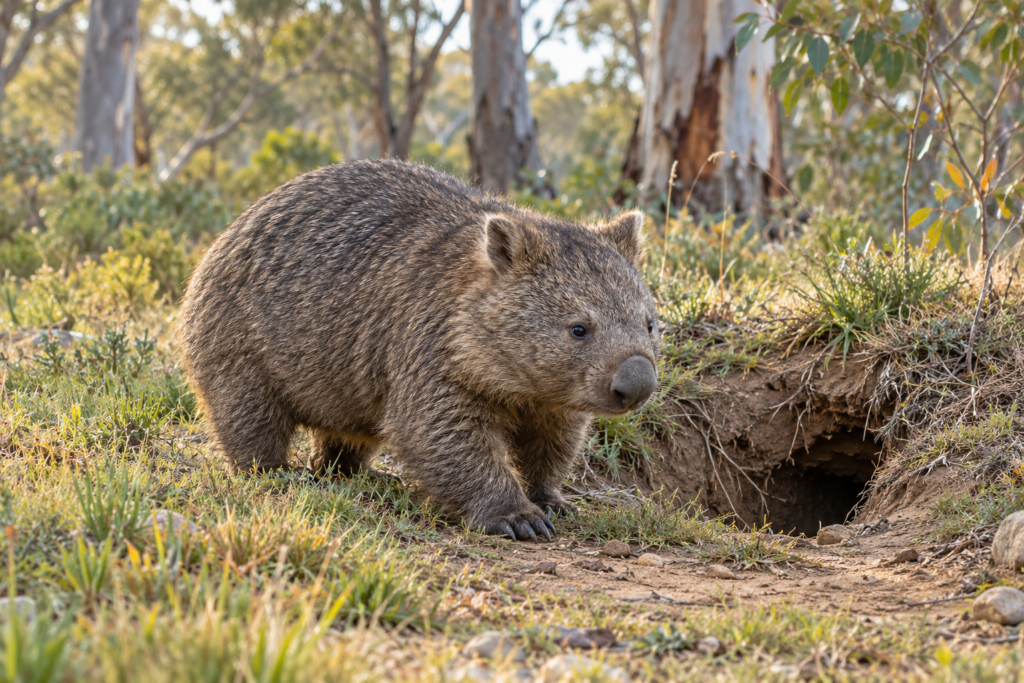
Wombats leave droppings in noticeable places, including around rocks and logs, to communicate with other wombats.
One possible advantage of cubes is that they are less likely to roll away. Picture placing a marble and a small wooden block on a sloping rock. Which one would stay put more easily?
However, a possible benefit is different from a proven reason the shape evolved. Researchers have explained how wombats make cubes, but the evolutionary “why” still needs more investigation.
You might think of a dropping as a wombat’s smelly little message board. Fortunately, humans invented texting.
Does the Poop Become Square When It Comes Out?
No. The cubes already exist inside the intestine. Researchers found that cube formation happens near the end of the digestive tract. The exit does not stamp round poop into square pieces.
So there’s no tiny cookie cutter involved—although that would make an unforgettable science diagram.
A Question to Ask Your Child
“If you discovered an animal with cube-shaped poop, how would you figure out what makes the corners?”
Would you watch the animal? Examine its droppings? Study its digestive system? Build a model?
That funny question opens the door to a bigger idea: science often begins when someone notices something strange and asks, “How does that happen?”
Even a question about poop can lead to a real discovery.
Curious about more wonderfully weird animals? Explore Weird Animals, Mammals by Dean R Giles, and keep the animal questions coming!