

Star-nosed moles have star-shaped noses to help them find food by touch. The 22 fleshy rays around their nostrils carry thousands of tiny sensory organs that detect contact with nearby objects. This sensitive nose helps the mole locate small prey where seeing is difficult.
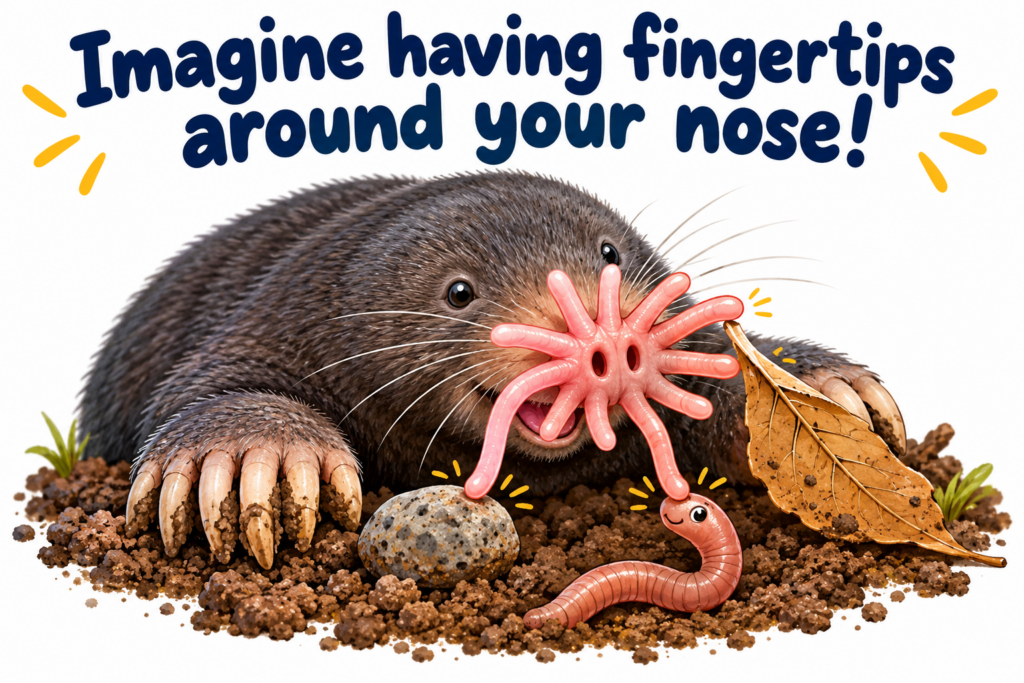
At first glance, a star-nosed mole looks as though a tiny pink sea creature has landed on its face.
But those wiggly little rays belong there. They make up a remarkable tool for exploring the world—and finding dinner.
Imagine having a set of super-sensitive fingertips around your nose. Every time you touched something, you would learn about what was in front of you.
That gives you an idea of how useful this unusual face can be.
What Are the Little “Tentacles” on Its Nose?
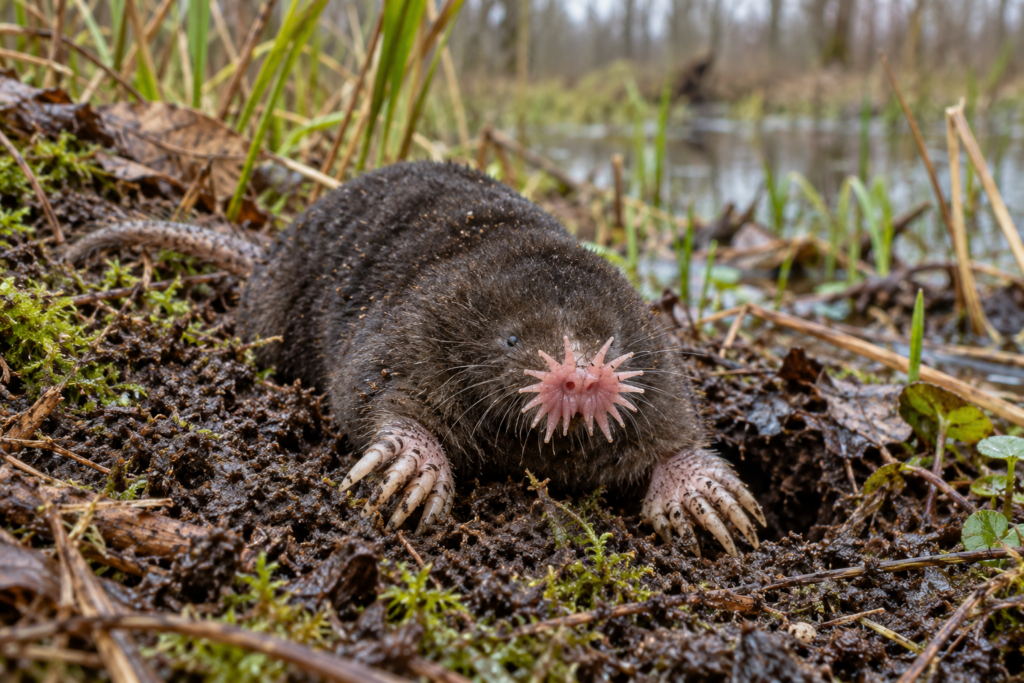
The nose has 22 fleshy extensions called rays, with 11 on each side. Their surfaces are covered with roughly 25,000 tiny touch organs called Eimer’s organs. These structures help the mole detect fine details through contact.
The rays may resemble miniature fingers, but they aren’t little hands. They form a specialized sensory surface around the nostrils.
Think of the star as a touch detector that travels everywhere with the mole. It never needs batteries, and it is always right under its nose.
Or, more accurately, it is its nose.
How Does the Nose Help It Find Food?
The mole rapidly touches its surroundings with the star, then examines possible food more closely. During a search, it can touch its nose to about 10–13 different places in a single second.
Try tapping your finger on several spots on a table in one second. Now imagine using those touches to figure out which spot holds something edible.
That is a demanding job for a sensory system!
The mole’s nose helps it locate very small prey efficiently. Researchers link this ability to an important advantage: finding tiny meals that would otherwise be difficult to detect and handle quickly.
For a hungry mole, an unusual nose is excellent equipment.
Does It Use the Whole Star in the Same Way?
Different parts of the star have different roles. A small central pair of rays acts as an area for especially detailed touch, helping the mole investigate objects it has detected. Scientists call this a tactile fovea—a specialized region for close examination by touch.
You can picture the difference between brushing your hand across a surface and then using a fingertip to examine one tiny bump.
The mole can search broadly, then give a possible meal a closer inspection.
Can Star-Nosed Moles Really Smell Underwater?
Yes. Star-nosed moles can sample underwater smells by blowing out air bubbles and quickly drawing them back into their nostrils. The bubbles contact an object or scent trail and carry odor molecules back to the nose.
That is different from simply breathing water into the nose. The mole uses air bubbles as little scent collectors.
Imagine sending a tiny bubble out to investigate something, then pulling it back for a sniff.
Suddenly, blowing bubbles sounds like serious detective work.
Is the Star Mainly for Touch or Smell?
The fleshy star is primarily a touch organ. Its thousands of sensory structures respond to physical contact. Underwater sniffing is another ability that works alongside this extraordinary sense of touch.
So, although we usually think of noses as smelling tools, this animal’s nose does much more.
A Fun Question to Ask Your Child
“If you had to find something without looking, what body part would you use?”
Try placing a few familiar objects inside a bag. Without peeking, feel one object at a time and describe its shape and texture before guessing what it is.
That activity gives children a small taste of gathering information through touch. Now imagine having that ability built into your face!
The star-nosed mole may look strange to us, but its nose helps it solve an everyday problem: finding its next meal.
Want to meet more animals with surprising abilities? Explore Weird Animals, Mammals by Dean R Giles and keep discovering the wonderfully unusual side of nature.