
Robots usually explore planets before people because they can travel into dangerous environments without risking human lives. They do not need food, water, oxygen, sleep, or a return trip home. Robotic spacecraft can also test landing sites, study hazards, and collect information that may make future human missions safer.
Sending a person to another world is enormously difficult. Sending a robot is difficult too, but robots can survive journeys and conditions that people cannot yet safely handle.
Robots do not need life-support systems
People need oxygen to breathe, water to drink, food to eat, and protection from extreme temperatures and radiation. Astronauts also need room to move, equipment to exercise, medical supplies, and systems for removing waste and carbon dioxide.
All of that equipment adds size and weight to a spacecraft. A larger spacecraft requires more fuel and a more powerful rocket.
A robot does not need air, food, water, or sleep. Engineers can build it with only the instruments and systems needed for its mission. This often makes robotic exploration more practical than immediately sending people.
Robots can enter dangerous environments
Other worlds can be extremely hostile.
Venus has crushing atmospheric pressure and surface temperatures hot enough to melt lead. Mars has a thin atmosphere, intense cold, dust, and more surface radiation than Earth. Jupiter is surrounded by powerful radiation, while moons and asteroids may have unfamiliar terrain and extremely weak gravity.
A robot can be designed for a particular danger. Engineers can add heat protection, radiation shielding, strong wheels, special landing legs, or instruments that work in extreme cold.
If a robotic mission fails, the loss is painful and expensive—but no astronaut’s life is lost.
Robots can travel for years
Some destinations in the solar system are so distant that reaching them takes years.
NASA’s Voyager spacecraft have operated for decades. Europa Clipper is traveling approximately 1.8 billion miles along its route to Jupiter and is expected to arrive in 2030. Other robotic missions travel even farther from Earth.
A human crew would need enough food, water, oxygen, power, medical support, and protection for the entire journey. The astronauts might also need the fuel and supplies required to return home.
Robots can spend years traveling in a small spacecraft and begin working when they reach their destination.
Robots do not always need to come home
Most robotic explorers are not designed to return to Earth. They send their discoveries home using radio signals.
Orbiters can photograph a world from above. Landers can study one location. Rovers can move across the surface, and some spacecraft can fly past several planets, moons, asteroids, or comets.
A human mission is different. Bringing astronauts home safely is one of its most important requirements. That means the mission may need a return spacecraft, additional fuel, more supplies, and equipment that can launch from another world.
A robot can remain at its destination after its work is complete.
Robots can serve as scientific scouts
Before people travel somewhere unfamiliar, it helps to know what they will find.
Robotic missions can:
- Photograph possible landing areas
- Map mountains, craters, rocks, and other obstacles
- Measure temperature and radiation
- Examine dust and soil
- Search for water or useful minerals
- Test landing technology
- Study local weather
- Identify dangers astronauts might face
In this way, robots act as scouts. Their discoveries help scientists and engineers decide where people might land, what equipment they would need, and how they could remain safe.
NASA’s robotic missions have explored destinations throughout the solar system, including the Moon, Mars, Venus, Jupiter, Saturn, asteroids, and comets. NASA’s Jet Propulsion Laboratory mission directory shows the many types of robotic spacecraft used for exploration.
Do scientists control space robots in real time?
Sometimes—but not always.
Commands and information travel between Earth and a spacecraft as radio signals. Those signals move at the speed of light, but space is so large that the trip can still take minutes or hours.
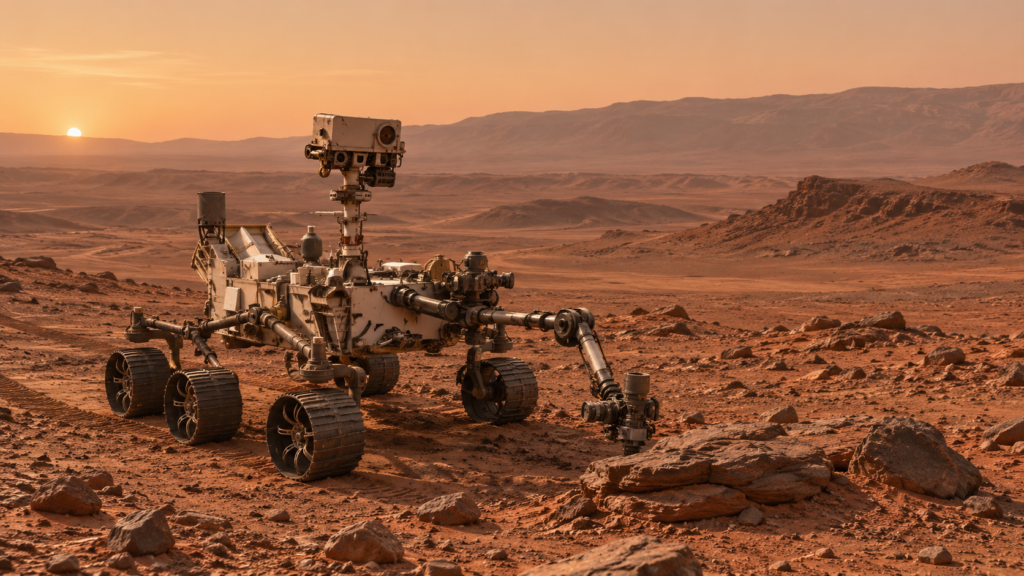
When Mars is favorably positioned, a radio signal still takes several minutes to travel between Earth and Mars. A person on Earth therefore cannot drive a Mars rover as if it were a remote-controlled car.
Instead, a team plans the rover’s movements and sends instructions. The rover may use cameras, sensors, and onboard software to recognize hazards and carry out parts of the plan safely.
The farther away a robot travels, the more important this ability to work independently becomes.
Are robots better explorers than people?
Robots and people have different strengths.
Robots can endure dangerous conditions, perform repeated measurements, and remain on another world for years. People can respond creatively, repair equipment, notice unexpected details, and make complicated decisions much more quickly.
An astronaut can look at an unusual rock, connect it with other observations, and change the day’s plan almost immediately. A robot may need to send information to Earth and wait for new instructions.
Robots are not simply replacements for human explorers. They are partners that can go first, gather information, and prepare the way.
How have robots prepared the way for astronauts?
Before Apollo astronauts landed on the Moon, robotic spacecraft photographed the lunar surface and tested landing techniques. Those missions helped scientists study possible landing areas.
Robots continue to examine the Moon and Mars today. They map the terrain, study radiation, search for water, and test technologies that could support future explorers.
A robotic scout can answer essential questions before a crew leaves Earth:
- Is the ground safe enough for landing?
- How cold will it become?
- How much radiation will astronauts encounter?
- Is water available?
- What kind of dust could damage equipment?
- Can a spacecraft communicate reliably with Earth?
Every answer can help engineers design a safer human mission.
A simple robot-explorer activity for kids
Create an imaginary planet with pillows, blocks, paper “craters,” and other household objects. Do not let your child enter the area at first.
Instead, ask your child to design a robotic explorer on paper. The robot should have tools that help it investigate the unknown world.
It might need:
- Wheels or legs
- A camera
- A thermometer
- A robotic arm
- A rock-testing instrument
- A radio antenna
- Solar panels or another power source
Ask your child what the robot should learn before a person visits the planet. Then let the child guide a toy robot through the imaginary landscape and report the hazards it discovers.
Frequently asked questions
Why can robots survive where people cannot?
Robots do not need breathable air, food, water, or comfortable temperatures. Engineers can build them to tolerate specific environmental dangers.
Are all space robots rovers?
No. Space robots include orbiters, landers, rovers, probes, helicopters, and spacecraft that fly past distant worlds.
Do space robots use artificial intelligence?
Some robots use onboard software to recognize hazards, navigate, select targets, or complete parts of a task independently. Human teams still plan missions and send commands.
Why can’t scientists drive a Mars rover with a joystick?
Radio signals take time to travel between Earth and Mars. By the time a scientist saw a danger and sent a command, the rover could already have encountered it. Rovers therefore move carefully and have some ability to detect hazards themselves.
Will robots explore every planet before people arrive?
Robotic missions are likely to investigate any destination before astronauts land there. Some worlds are so distant or dangerous that robots may remain our only practical explorers for a very long time.
Will people eventually explore Mars?
Space agencies are studying the technologies needed for future human exploration of Mars, but sending people there safely and bringing them home will require overcoming major engineering and health challenges.
The quick answer: Robots explore planets first because they can face dangerous conditions, travel for years, and gather vital information without risking human lives. Their discoveries help us understand other worlds—and may make it safer for people to follow someday.