

Venus is the hottest planet in our solar system—even though Mercury is closer to the Sun. Venus is hotter because its thick atmosphere traps heat, while Mercury has almost no atmosphere to hold heat near its surface.
Venus has an average surface temperature of about 867°F (464°C). That is hot enough to melt lead. Mercury can become extremely hot during the day, but it also becomes extremely cold at night.
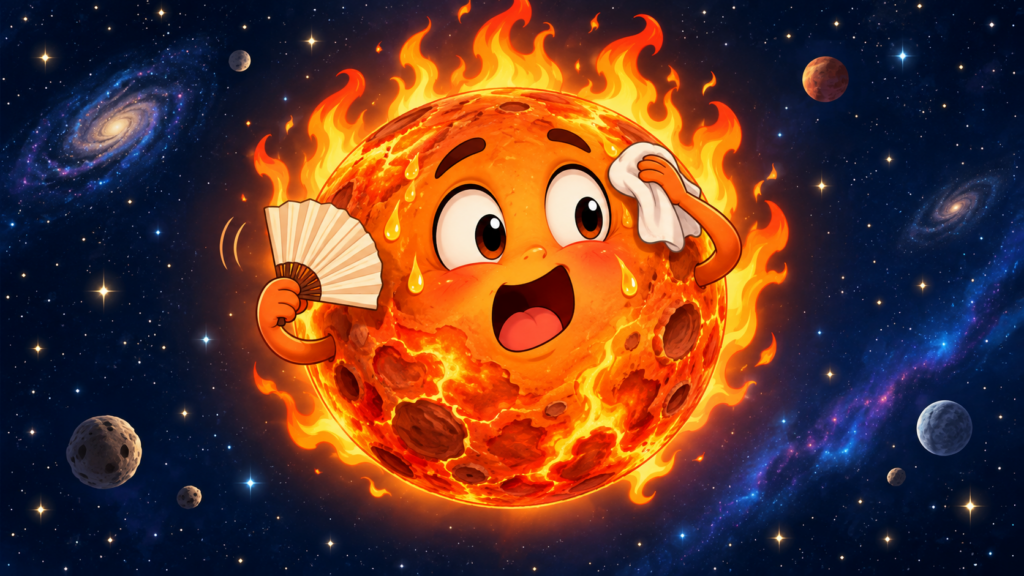
Why would we expect Mercury to be the hottest planet?
Mercury is the closest planet to the Sun. It travels around the Sun at an average distance of about 36 million miles, while Venus is approximately 67 million miles away.
From Mercury’s surface, the Sun would appear more than three times as large as it does from Earth. The sunlight can be as much as seven times brighter.
With so much sunlight reaching Mercury, it seems reasonable to assume that it must be the hottest planet. During the day, temperatures on Mercury can reach approximately 800°F (430°C).
However, distance from the Sun is not the only thing that controls a planet’s temperature. Its atmosphere also makes a tremendous difference.
Why is Venus hotter than Mercury?
Venus is surrounded by an extremely thick atmosphere made mostly of carbon dioxide. Sunlight passes through the atmosphere and warms the planet’s surface.
The warm surface then releases some of that energy as heat. Instead of escaping easily into space, much of the heat becomes trapped by the atmosphere.
This process is known as the greenhouse effect.
Earth also has a natural greenhouse effect. Our atmosphere holds in enough heat to help keep the planet warm enough for life. Venus has a much more extreme version called a runaway greenhouse effect.
The atmosphere of Venus traps so much heat that the planet remains extremely hot during the day and at night. It is also very hot near the equator and closer to the poles.
Venus is like a planet wrapped in an enormous heat-trapping blanket.
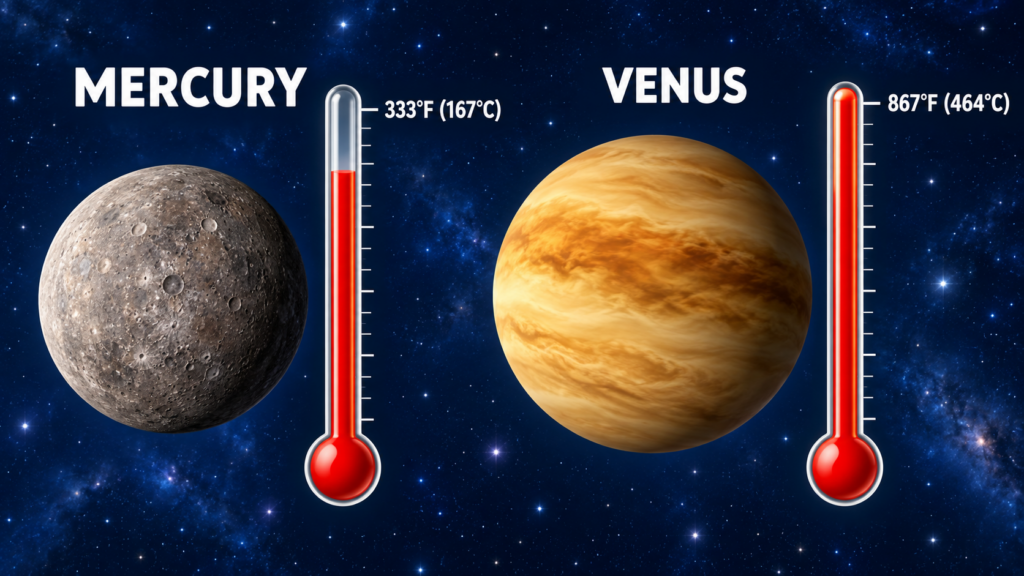
Why doesn’t Mercury hold on to its heat?
Mercury has only an extremely thin layer of gases around it called an exosphere. It does not have a substantial atmosphere like Earth or Venus.
During Mercury’s long daytime, the surface absorbs intense energy from the Sun and becomes extremely hot. When an area rotates away from the Sun, however, its heat can escape into space.
As a result, nighttime temperatures on Mercury can fall to approximately −290°F (−180°C). The difference between its daytime and nighttime temperatures can be more than 1,000°F.
Mercury experiences both scorching heat and bitter cold. Venus does not cool down nearly as much because its thick atmosphere continues holding heat near the surface.
Is every part of Mercury hot?
No. Some places on Mercury may remain cold enough for water ice.
There are deep craters near Mercury’s north and south poles where sunlight never reaches the bottom. Because these areas remain permanently shadowed, scientists have found evidence that water ice can survive inside them.
That means the closest planet to the Sun can have both extremely hot ground and permanently frozen water.
What would it be like on Venus?
Standing on Venus would be impossible without specialized protection.
In addition to the intense heat, the atmosphere creates crushing pressure at the surface. NASA compares the pressure to being more than 3,000 feet underwater on Earth. Venus is also covered by clouds containing sulfuric acid.
A person would not survive there, and even robotic spacecraft have difficulty operating on the surface for very long.
Venus may sometimes be called Earth’s twin because the two planets are similar in size and structure, but their surface environments are dramatically different.
Children’s activity: Which cup holds its heat?
This simple activity can help children see how insulation slows the escape of heat.
What you will need
- Two identical cups
- Warm water
- A towel or thick cloth
- Two thermometers, if available
- A timer
- An adult to supervise
What to do
- Ask an adult to place the same amount of warm water in each cup.
- Measure the starting temperature of both cups, or touch the outside of each cup carefully to confirm that they feel equally warm.
- Leave one cup uncovered.
- Wrap the second cup in the towel or thick cloth.
- Wait 15 to 20 minutes.
- Measure the temperature of both cups again.
- Compare the results.
The wrapped cup should remain warmer because the towel slows the movement of heat into the surrounding air.
What does this show?
The towel does not create heat. It helps keep heat from escaping.
Venus’s atmosphere is not exactly like a towel, so this is only a simple model. However, it helps demonstrate the central idea: how quickly a world loses heat can be just as important as how much sunlight it receives.
Ask your child:
- Which cup stayed warmer?
- Did the towel produce any new heat?
- What happened to the heat in the uncovered cup?
- How is the wrapped cup a little like Venus?
- How is the uncovered cup a little like Mercury?
Summary
Venus is the hottest planet in our solar system because its thick, carbon-dioxide-rich atmosphere traps heat through an extreme greenhouse effect.
Mercury receives more direct sunlight because it is closer to the Sun. Its daytime surface can become incredibly hot, but it has almost no atmosphere to retain that heat. When night arrives, the surface cools dramatically.
The quick answer: Mercury receives more heat from the Sun, but Venus holds on to heat much more effectively. That thick heat-trapping atmosphere makes Venus—not Mercury—the hottest planet.
Looking for some fun Solar System facts? Look no further!