

NASA is sending a flying robot to Titan because this unusual moon may help scientists understand how the chemical ingredients for life develop. Titan’s thick atmosphere and low gravity also make flying an excellent way to explore many different locations.
The robot, named Dragonfly, is a large rotorcraft that resembles a drone. NASA currently plans to launch Dragonfly no earlier than July 2028, with arrival at Titan expected in late 2034.

What is Titan?
Titan is the largest moon of Saturn and the second-largest moon in the Solar System. It is even larger than the planet Mercury.
Titan is especially interesting because it is the only moon known to have a thick atmosphere. Its surface also has clouds, rain, rivers, lakes, and seas.
However, those rivers and lakes are not filled with liquid water. Titan is so cold that they contain liquid methane and ethane—substances that exist as gases on Earth under ordinary conditions.
Beneath Titan’s frozen surface, scientists also believe there is an enormous ocean of liquid water.
What is Dragonfly?
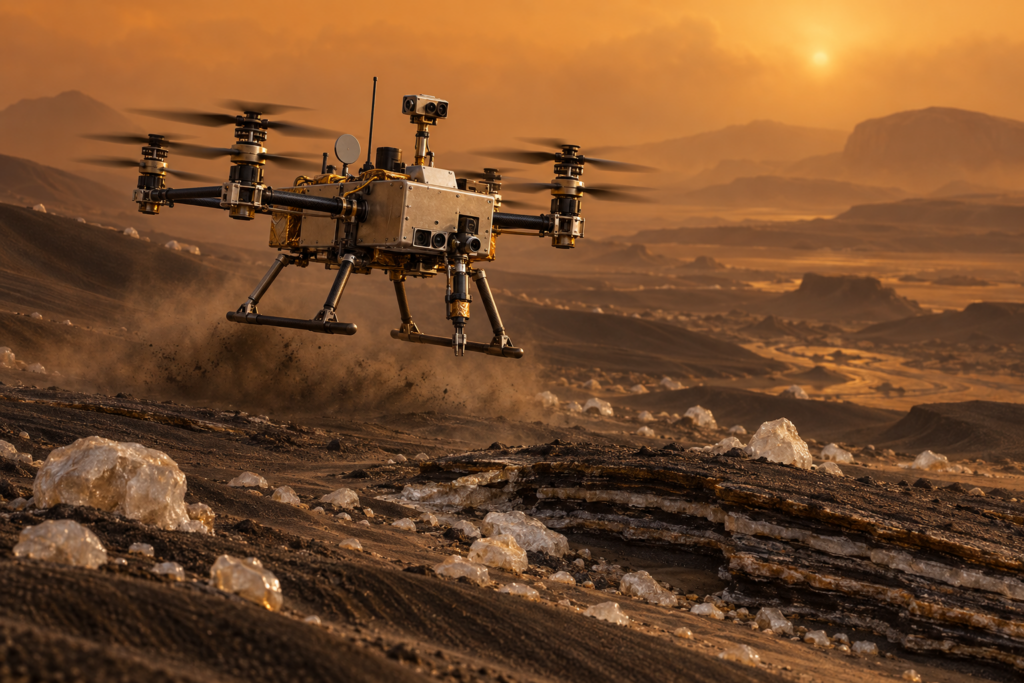
Dragonfly is an eight-rotor robotic aircraft designed to fly through Titan’s atmosphere and land in different locations.
It is much larger than a recreational drone. Dragonfly will be about 12½ feet wide and weigh approximately 1,900 pounds on Earth. It will carry cameras, drills, weather instruments, and devices that can examine the chemical composition of Titan’s surface.
Dragonfly will fly to a location, land, conduct scientific experiments, and then fly to another location. NASA expects it to investigate approximately 20 to 30 sites during its primary mission.
Why does NASA want to explore Titan?
Scientists are interested in Titan because it contains large amounts of organic material.
In science, the word organic usually refers to compounds that contain carbon. Carbon is one of the essential ingredients in life as we know it, but the presence of organic compounds does not automatically mean that something is alive.
Titan’s atmosphere produces complex carbon-containing molecules. These materials fall onto the surface, where they may mix with other substances.
NASA wants Dragonfly to study this chemistry and investigate how far it has progressed toward the kinds of chemical processes that existed before life appeared on Earth.
Dragonfly is not primarily being sent to discover living creatures. Its central mission is to investigate habitability and prebiotic chemistry—the chemistry that may occur before biology begins.
Why send a flying robot instead of a rover?
A rover can only examine places it can reach by driving. Rocks, steep slopes, sand dunes, and other obstacles may block its route or slow it down.
Dragonfly will be able to fly over many of those obstacles.
Titan is also one of the best places in the Solar System for an aircraft. Its atmosphere is much denser than Earth’s, while its gravity is only about one-seventh as strong. The thick air helps support the rotorcraft, and the weak gravity makes it easier for the robot to lift off.
Dragonfly will be able to travel several miles during a single flight. During its planned mission of more than three years, it may cover approximately 70 miles from its original landing location.
Where will Dragonfly go?
Dragonfly will begin by exploring areas covered with dunes made from organic material. It will collect samples, study the atmosphere, photograph the landscape, and measure conditions on and below the surface.
One of its most important destinations will be Selk Crater, an impact crater approximately 50 miles wide.
Scientists believe the impact that formed Selk Crater may have melted some of Titan’s water ice. Liquid water could then have mixed with organic molecules for thousands of years before freezing again.
Dragonfly will investigate whether this ancient mixture allowed important chemical reactions to occur. The frozen material may offer clues about processes that took place on the young Earth before life developed.
What will Dragonfly look for?
Dragonfly will use its scientific instruments to investigate several important questions:
- What chemicals are present on Titan?
- How are complex organic molecules formed?
- Did liquid water and organic material ever mix?
- How far has Titan’s prebiotic chemistry progressed?
- Could any part of Titan support life?
- Is Titan’s surface changing?
- Are there Titan quakes or other activity below the surface?
- What are Titan’s weather and atmospheric conditions like?
Dragonfly will drill into the surface and transfer samples to an instrument that identifies their chemical components. It will also take photographs, study Titan’s weather, measure the elements in the ground, and listen for seismic activity.
Will Dragonfly search for aliens?
Dragonfly is not designed to look for large creatures or photograph aliens walking across Titan.
It will search for chemical evidence that helps scientists understand whether Titan has—or once had—conditions that could support life. It may also look for chemical indicators associated with possible water-based or hydrocarbon-based life.
Finding an interesting chemical is not the same as proving that life exists. Scientists would have to consider nonliving processes that could produce the same chemical before reaching such an important conclusion.
Even if Dragonfly finds no signs connected with life, its discoveries could still teach us how complex chemistry develops on distant worlds.
How will Dragonfly operate so far from Earth?
Titan is so far away that radio messages take well over an hour to travel between Earth and the Saturn system. Scientists will not be able to control Dragonfly with a joystick in real time.
Instead, they will send plans and instructions to the robot. Dragonfly will then use its computers, cameras, and sensors to carry out many tasks safely on its own.
After landing, it can examine its surroundings and send scientific information back to Earth through NASA’s Deep Space Network.
How will Dragonfly get power?
Sunlight at Saturn is much weaker than sunlight near Earth, and Titan’s hazy atmosphere blocks some of the light that does arrive. Solar panels would therefore have difficulty producing enough dependable power for the mission.
Dragonfly will use a radioisotope thermoelectric generator. This device converts heat produced by the natural decay of radioactive material into electricity.
The system will provide dependable power in Titan’s cold, dim environment and recharge the batteries used for flight and scientific work. Similar power systems have been used on long-lasting Mars rovers, including Curiosity and Perseverance.
Will Dragonfly fly all the time?
No. Dragonfly will spend much more time on the ground than in the air.
Flying requires considerable energy, so the robot will recharge its batteries, conduct experiments, and communicate with Earth while resting on the surface. NASA expects it to make roughly one flight every one or two Titan days.
A Titan day lasts almost 16 Earth days. This gives Dragonfly plenty of time to study each location before moving on.
Children’s activity: Make a paper Dragonfly
Children can investigate how spinning blades slow a falling object by making a simple paper rotor.
What you need
- A strip of paper
- Scissors
- A paper clip
- A pencil
- A ruler
- An adult to supervise
What to do
- Cut a strip of paper approximately 2 inches wide and 8 inches long.
- Cut a line down the middle of the top third of the strip.
- Fold the two resulting flaps in opposite directions to form rotor blades.
- Fold the lower sides inward to make a narrow body.
- Attach a paper clip to the bottom.
- Hold the paper rotor above your head and release it.
- Watch as it spins while falling.
- Change the length or angle of the blades and test it again.
Ask your child:
- Which design stayed in the air longest?
- What happened when you added another paper clip?
- Did wider blades change the way it fell?
- Why might thick air make it easier for Dragonfly to fly?
- How would low gravity affect the aircraft?
Explain that Dragonfly uses powered rotors rather than simply falling, but both designs depend on blades moving through an atmosphere.
Frequently asked questions
Is Titan a planet?
No. Titan is a moon that orbits Saturn.
Is Dragonfly a helicopter?
Dragonfly is an octocopter, a type of rotorcraft with eight rotor assemblies. It operates somewhat like a very large drone.
Are there lakes on Titan?
Yes. Titan has lakes and seas filled mainly with liquid methane and ethane. It is the only world besides Earth known to have stable liquids on its surface.
Could people live on Titan?
Titan is not currently suitable for people. It is extremely cold, its atmosphere does not contain breathable oxygen, and reaching it requires a journey lasting several years.
When will Dragonfly launch?
NASA currently lists Dragonfly’s launch as no earlier than July 2028. Mission schedules can change as development and testing continue.
When will Dragonfly reach Titan?
Dragonfly is expected to arrive in late 2034.
Why is the mission named Dragonfly?
Like the insect, the spacecraft can fly, hover, land, and move between different locations. Its multiple rotors will allow it to explore far more territory than a stationary lander.
Summary
The quick answer: NASA is sending the flying robot Dragonfly to Titan to investigate its complex chemistry and learn whether this distant moon has conditions that could support life.
Titan is an ideal destination for a flying robot because it has a thick atmosphere and low gravity. Dragonfly will fly over difficult terrain, land at multiple sites, drill into the ground, study samples, photograph the landscape, monitor the weather, and investigate what lies beneath the surface.
It may not find life, but Dragonfly could help answer an even more fundamental question: How does a lifeless world develop the chemical ingredients that may eventually make life possible?