
Yes. You can see Mercury, Venus, Mars, Jupiter, and Saturn without a telescope when they are above the horizon and in a favorable position. They usually resemble bright stars, although each planet has clues that can help you identify it.
Uranus is technically visible under exceptionally dark skies to people with excellent eyesight, but binoculars or a telescope are normally needed. Neptune cannot be seen with the unaided eye.
Why can we see planets from Earth?
Planets do not produce their own visible light. Instead, they reflect sunlight toward Earth.
Even though planets are enormous, they are so far away that most look like small points of light when viewed without magnification. You will not see Saturn’s rings, the clouds of Jupiter, or the surface of Mars with your unaided eyes—but you can still see the planets themselves.
How can you tell a planet from a star?
A planet often shines more steadily than a star.
Stars frequently appear to twinkle because their light is disturbed by movement in Earth’s atmosphere. Planets are closer and appear as tiny disks rather than single points of light, so their light is usually less affected.
However, the “planets do not twinkle” rule is only a clue. A planet near the horizon may shimmer because its light must pass through more of the atmosphere.
Planets also follow similar paths across the sky. They are usually found near the same broad path traveled by the Sun and Moon, called the ecliptic.
Which planets can you see without a telescope?
Mercury
Mercury can be seen without a telescope, but it is often the most difficult naked-eye planet to find.
Because Mercury orbits close to the Sun, it never appears very far from the Sun in our sky. Look for it low on the horizon shortly before sunrise or shortly after sunset.
Venus
Venus is usually the easiest planet to recognize because it is extremely bright.
It is often called the Morning Star or Evening Star, although it is a planet rather than a star. Like Mercury, Venus is always seen somewhere near the rising or setting Sun. It can remain visible for a couple of hours before sunrise or after sunset.
Mars
Mars can look like a bright orange or reddish point of light.
Its brightness changes considerably as Earth and Mars travel around the Sun. At certain times, Mars is bright and easy to recognize. At others, it may be less noticeable.
Jupiter
Jupiter is one of the brightest objects in the night sky.
It usually appears as a brilliant cream-colored or white point of light. With steady binoculars or a small telescope, you may also see some of Jupiter’s four largest moons lined up beside it.
Saturn
Saturn usually resembles a steady, pale-golden star.
Its famous rings cannot be seen with the unaided eye. A small telescope, however, can reveal them and transform an ordinary-looking point of light into one of the most memorable sights in the sky.
Can you see all five visible planets at once?
Sometimes, but not usually.
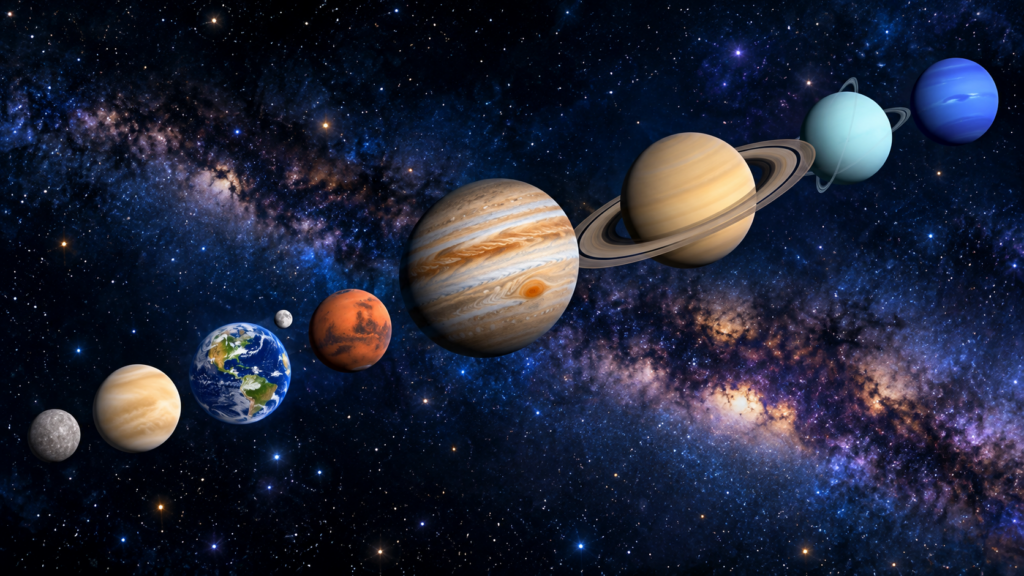
The planets are constantly traveling around the Sun at different speeds. From Earth, this makes them appear in different parts of the sky at different times. Occasionally, all five naked-eye planets are visible during the same evening or morning. This is sometimes described as a planetary alignment or planet parade.
More often, you will see only one, two, or three planets at a time.
What about Uranus and Neptune?
Uranus is near the limit of human eyesight. Under very dark skies, a person with excellent vision may be able to see it—but only if they know precisely where to look. Binoculars or a telescope make finding it much more practical.
Neptune is too faint to see without optical help. You will need at least binoculars or a telescope, a detailed sky chart, and favorable viewing conditions to locate it.
What is the best way to find a planet?
Begin by checking a current sky chart, astronomy website, or planetarium app. Planet positions change, so a guide created for your location and date will be more helpful than a permanent map.
For a better view:
- Choose a night with clear skies.
- Find an open area with a wide view of the horizon.
- Move away from bright streetlights when possible.
- Give your eyes about 15 to 20 minutes to adjust to the darkness.
- Look for a bright point that shines more steadily than nearby stars.
- Observe it again over several nights and notice whether its position changes.
Bright planets such as Venus and Jupiter can often be seen from towns and cities despite light pollution.
Important Sun-safety reminder
Never look directly at the Sun. Never point binoculars, a telescope, or a camera toward the Sun unless the equipment has a properly fitted solar filter designed for that purpose.
This warning is especially important when searching for Mercury or Venus because these planets often appear in the part of the sky near sunrise or sunset. An adult should supervise children during twilight observations.
Children’s activity: Planet or star?
Help children practice identifying a planet by keeping a simple night-sky observation log.
What you need
- A notebook
- A pencil
- A current sky map or planetarium app
- A safe outdoor viewing location
- A red-covered flashlight, if available
What to do
- Use the sky map to select one planet that should be visible from your location.
- Record the date and time.
- Write down the direction you are facing.
- Describe the object’s color and brightness.
- Decide whether its light appears steady or twinkling.
- Compare it with two nearby stars.
- Observe the same area on two or three additional nights.
Ask your child:
- Does the planet look brighter than the surrounding stars?
- Does it twinkle as much as they do?
- Has it moved compared with the background stars?
- Can you identify it without checking the map first?
This activity introduces careful observation while showing children that the night sky changes from one evening to another.
Frequently asked questions
Can you see Saturn’s rings without a telescope?
No. Saturn looks like a bright point to the unaided eye. A small telescope can reveal its rings.
Can you see Jupiter’s moons without a telescope?
They are not normally visible to the unaided eye. Binoculars may reveal some of Jupiter’s largest moons under good conditions, although a small telescope provides a clearer view.
Why is Venus called the Morning Star or Evening Star?
Venus is so bright that ancient observers compared it with the brightest stars. However, Venus is a planet. The name describes when it appears, not what it is.
Do planets ever twinkle?
Planets usually twinkle less than stars, but they may shimmer when they are low in the sky or when Earth’s atmosphere is especially turbulent.
Can you see planets from a city?
Yes. Venus, Mars, Jupiter, and Saturn can often be seen from cities. Mercury is possible too, but finding a clear horizon may be difficult.
Summary
The quick answer: Mercury, Venus, Mars, Jupiter, and Saturn can all be seen without a telescope.
Venus and Jupiter are often the easiest to spot because they are extremely bright. Mars may have a reddish color, while Saturn often looks pale gold. Mercury is more challenging because it stays close to the Sun in the sky.
The planets may resemble stars at first, but their steady glow, position along the ecliptic, and gradual movement against the background stars can help you recognize them. All you need to begin exploring the planets is a clear sky, a safe viewing spot, and the patience to look up.