

You love your children. You enjoy hearing their stories, helping them learn, and watching them discover the world.
But sometimes, you desperately need twenty minutes when no one is calling your name.
Not twenty minutes spent scrolling on your phone while still answering questions every thirty seconds.
Not twenty minutes spent worrying about what your child is watching on a screen.
You need a real break—a short period when your child is safely and happily occupied, and you are free to breathe, think, finish a task, or simply sit quietly.
See More Here: https://amzn.to/4hbQhEV
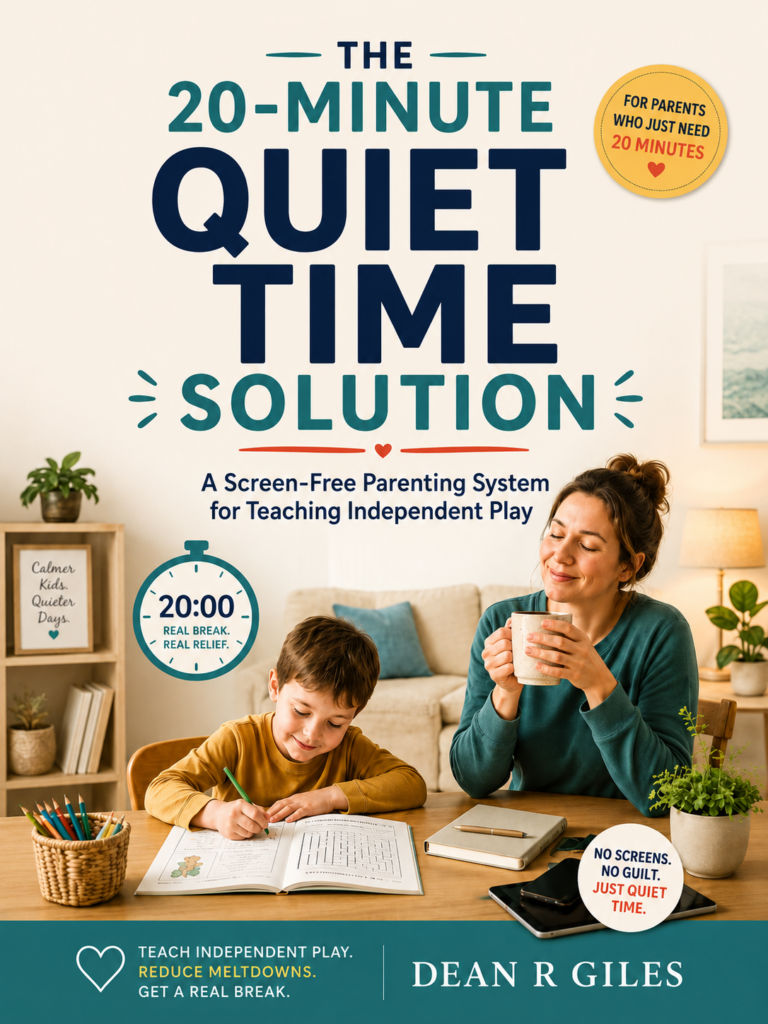
That is the purpose of The 20-Minute Quiet Time Solution.
Why Twenty Minutes Can Feel Impossible
For many parents, the day begins with someone needing something and continues that way until bedtime.
There are meals to prepare, messes to clean, appointments to remember, work to complete, and endless questions to answer. Even a trip to the bathroom can be interrupted.
When parents finally reach their limit, handing a child a tablet can seem like the only realistic way to create a little peace.
Screens may provide immediate relief, but they do not always produce the kind of break parents truly need. You may still be monitoring content, negotiating when it is time to stop, or dealing with frustration and irritability afterward.
What parents need is not another complicated parenting strategy. They need a practical way to help their children become comfortable playing and working independently.
Quiet Time Is a Skill Children Can Learn
Some children naturally disappear into a pile of blocks, a coloring book, or an imaginary world. Others need more help learning how to play independently.
Independent play is not simply something a child either can or cannot do. It is a skill that can be introduced, practiced, and strengthened over time.
A child who constantly asks for entertainment may not be trying to make life difficult. The child may genuinely be unsure what to do without an adult directing the activity.
That is why saying, “Go play by yourself,” often does not work.
Children usually need:
- Clear expectations
- An activity that matches their age and abilities
- A predictable beginning and ending
- Practice staying with the activity
- Encouragement when they succeed
The 20-Minute Quiet Time Solution helps parents create these conditions without turning quiet time into another exhausting battle.
This Is Not About Ignoring Your Child
Wanting a break does not make you selfish.
It makes you human.
Parents cannot remain patient, creative, attentive, and emotionally available without occasionally stepping away to recharge. A short break can help you return to your child calmer and more capable of handling the rest of the day.
Quiet time is also valuable for children. It gives them an opportunity to make choices, solve small problems, develop confidence, and discover that they do not need constant outside entertainment.
The goal is not to push children away. The goal is to create a healthy rhythm in which together time and independent time can both exist.
What Can You Do With Twenty Quiet Minutes?
Twenty minutes may not sound like much, but it can completely change the direction of your day.
In twenty uninterrupted minutes, you might:
- Drink a cup of coffee while it is still warm
- Take a shower without an audience
- Answer an important email
- Fold a basket of laundry
- Prepare part of dinner
- Read a few pages of a book
- Sit in silence and do absolutely nothing
That last option counts.
You do not have to use every quiet moment to become more productive. Rest is a legitimate need.
A calmer parent is good for the entire family.
Why Puzzle and Activity Books Work So Well
One of the easiest ways to introduce quiet time is to provide an activity with a clear purpose.
A good puzzle or activity book gives a child something specific to do while still allowing the child to work independently. Unlike open-ended instructions such as “Find something to play with,” an activity page offers an immediate starting point.
Mazes, matching games, simple logic puzzles, coloring pages, hidden pictures, and other pencil-and-paper activities can hold a child’s attention without the overstimulation that often accompanies digital entertainment.
The best activities are:
- Appropriate for the child’s age
- Challenging without being frustrating
- Easy to begin without lengthy instructions
- Interesting enough to encourage continued effort
- Available only during quiet time, making them feel special
The activity itself matters, but the routine surrounding it matters even more.
Start Smaller Than Twenty Minutes
When a child is accustomed to constant interaction or entertainment, expecting twenty minutes of independent quiet time on the first day may lead to frustration.
Begin with a goal your child can successfully reach.
For some children, that may be three minutes. For others, it may be five or ten.
Choose the activity, explain what quiet time will look like, and set a visible timer. Let your child know what you will be doing nearby and what will happen when the timer ends.
When the child completes the time, recognize the success.
You might say:
“You worked on that all by yourself until the timer rang.”
This helps the child notice the skill being developed. Gradually extend the time as independent play becomes more familiar.
The objective is not immediate perfection. The objective is steady progress toward a reliable twenty-minute break.
Make Quiet Time Predictable
Children often cooperate better when they know what to expect.
Quiet time may work best when it happens at approximately the same point each day, such as:
- After lunch
- When a younger sibling naps
- After returning from school
- Before dinner preparation
- During a regular morning work period
A predictable routine reduces negotiation. Instead of quiet time appearing only when a parent is overwhelmed, it becomes a normal and expected part of the day.
The message changes from “Mom cannot handle any more noise” to “This is the time when everyone does something quietly.”
That difference can help quiet time feel safe rather than punitive.
Protect the Routine From Common Mistakes
Quiet time can become more difficult when expectations change from day to day.
Try to avoid using it only as a punishment. Children are less likely to embrace independent play when it is presented as a consequence for misbehavior.
Avoid choosing activities that require constant adult assistance. A craft with twelve steps and complicated supplies may create more work rather than less.
It is also helpful to decide in advance what counts as an interruption. Unless there is an emergency or a genuine need, encourage your child to keep small questions until the timer ends.
Consistency teaches children that you mean what you say—and that quiet time has a clear ending.
The Break You Need and the Skill Your Child Needs
Parents often feel guilty for wanting time away from the noise and demands of family life.
But creating twenty minutes of quiet time is not just about getting away from your child.
It is about teaching your child to feel capable without constant adult direction.
It is about replacing daily power struggles with a simple, repeatable routine.
It is about making space for both connection and independence.
And yes, it is also about giving you enough time to finish a cup of coffee, close your eyes, or remember what it feels like to hear yourself think.
Discover The 20-Minute Quiet Time Solution
The 20-Minute Quiet Time Solution is a practical guide for parents who need more than vague advice to “encourage independent play.”
It helps you understand why quiet time may be difficult for your child, how to introduce it without creating another battle, and how to build a routine that works for your family.
You will learn how to:
- Introduce independent activity in manageable steps
- Choose activities that hold a child’s attention
- Reduce dependence on screens for every quiet moment
- Handle interruptions and resistance
- Build toward twenty reliable minutes of independent play
- Create a routine that supports both children and parents
You do not need hours of silence.
You do not need a perfectly independent child.
You do not need another complicated system that requires more energy than you currently have.
You just need a realistic place to begin.
Your twenty-minute break may be closer than you think.
Get your copy of The 20-Minute Quiet Time Solution and begin building a calmer, more independent daily routine—twenty minutes at a time.