
Every parent knows the feeling.

The house is loud. The toys are everywhere. Someone wants a snack. Someone else needs help finding a shoe. The laundry is waiting, dinner is half-started, and your brain is begging for one small pocket of peace.
You do not need a full afternoon.
You do not need a perfect schedule.
You may not even need an hour.
Sometimes, what you really need is 20 minutes of quiet.
That is where the 20-minute quiet time trick comes in.
It is simple, realistic, and easy to start today. The idea is to give your child a small, focused, screen-free activity that keeps their hands busy and their mind engaged while you get a short break to reset, breathe, or finish one important task.
And one of the easiest ways to make it work?
A puzzle book.
Why 20 Minutes Matters
Twenty minutes may not sound like much, but for a busy parent, it can feel like a gift.
In 20 minutes, you can:
- Drink a cup of coffee while it is still warm
- Fold a load of laundry
- Answer an email
- Start dinner
- Make an important phone call
- Sit quietly and breathe
- Reset your patience before the next round of parenting begins
The goal is not to ignore your child. The goal is to teach your child how to enjoy a small block of independent quiet time.
That skill helps both of you.
Your child learns focus, patience, and independent play. You get a much-needed pause in the middle of the day.
What Is the 20-Minute Quiet Time Trick?
The 20-minute quiet time trick is a simple routine:
- Choose a calm, screen-free activity.
- Set a clear expectation.
- Give your child a specific place to sit.
- Let them work independently for 20 minutes.
- Praise the effort when they finish.
That is it.
No complicated setup. No elaborate craft supplies. No expensive subscription boxes.
Just a simple activity, a short time block, and a little consistency.
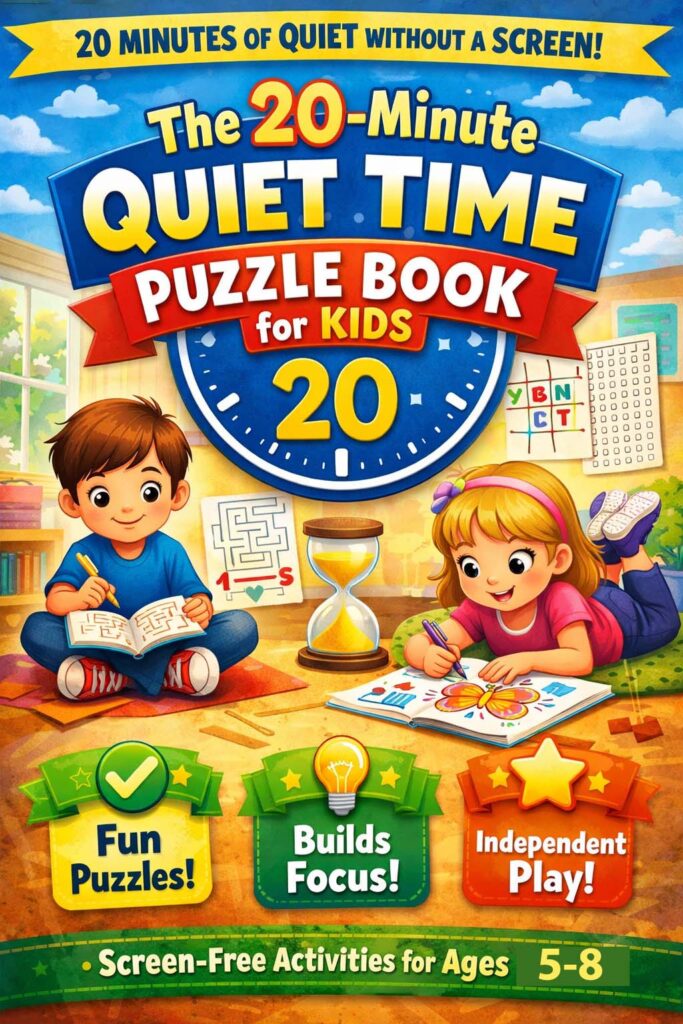
For many families, the easiest quiet-time activity is a puzzle book because it is already organized, low-mess, portable, and engaging.
Why Puzzle Books Work So Well for Quiet Time
Puzzle books are perfect for 20-minute quiet time because they give kids something active to do without requiring a screen.
A good puzzle book may include:
- Mazes
- Word searches
- Coloring pages
- Dot-to-dot activities
- Matching games
- Spot-the-difference pages
- Hidden pictures
- Simple logic puzzles
These activities work because they are clear and contained. Your child can look at the page and understand what to do.
There are no tiny pieces to scatter across the floor. No glue. No paint. No glitter. No major cleanup.
Just a pencil, crayons, and a page.
That makes puzzle books one of the easiest tools for parents who need a peaceful break.
The Secret: Make Quiet Time Feel Special
The trick works best when quiet time feels like a special routine instead of a punishment.
Do not present it as, “Go be quiet.”
Try something more inviting:
“Now it is your special puzzle time.”
“Let’s see how many pages you can finish before the timer rings.”
“You get to choose one maze, one coloring page, or one word search.”
“This is your quiet activity while I make lunch.”
Children respond better when they know what to expect and feel some ownership over the activity.
How to Set Up 20-Minute Quiet Time
You only need a few things:
- A puzzle book or printable activity pages
- A pencil
- Crayons or colored pencils
- A quiet place to sit
- A timer
Choose a place where your child can work comfortably. This could be the kitchen table, a small desk, a cozy corner, or even a clipboard on the couch.
Then say something simple:
“ For the next 20 minutes, this is your quiet puzzle time. You can color, do a maze, or work on a puzzle page. When the timer rings, we’ll look at what you finished.”
Keep the instructions short and clear.
Start Smaller If Needed
Some kids may not be ready for 20 minutes on the first try. That is okay.
Start with 5 or 10 minutes.
Then slowly build up.
Try this:
- Day 1: 5 minutes
- Day 2: 7 minutes
- Day 3: 10 minutes
- Day 4: 12 minutes
- Day 5: 15 minutes
- Day 6: 20 minutes
The goal is not perfection. The goal is practice.
Quiet time is a skill, and children often need help learning it.
Best Puzzle Activities for Quiet Time
Not every activity works equally well for every child. Some kids love coloring. Others love a challenge. Some want something silly. Some want something they can finish quickly.
Here are some great quiet-time puzzle options.
Mazes
Mazes are wonderful because they give kids a clear mission. They need to get from the start to the finish.
This builds problem-solving, patience, and pencil control.
Coloring Pages
Coloring is calming and creative. It is especially helpful for children who need to settle down after a busy morning or overstimulating activity.
Word Searches
Word searches are great for kids who know letters and are beginning to read. They help with focus, spelling, and visual tracking.
Dot-to-Dot Pages
Dot-to-dot activities help children practice number order while creating a fun picture.
Hidden Picture Pages
Hidden pictures keep kids searching, noticing, and concentrating. They are great for children who enjoy little discoveries.
Matching Activities
Matching pages are excellent for younger children. They can match animals, shapes, shadows, letters, numbers, or patterns.
When to Use 20-Minute Quiet Time
You can use this trick almost anytime your family needs a calmer moment.
It works especially well:
- Before dinner
- After lunch
- After school
- During a younger sibling’s nap
- While a parent works from home
- During phone calls
- On rainy days
- Before bedtime
- At restaurants
- In waiting rooms
- During church or meetings
- On road trips
Once your child understands the routine, you can use it in many different places.
That is another reason puzzle books work so well. They travel easily.
Create a Quiet-Time Basket
A quiet-time basket makes the routine even easier.
Fill a small basket or bin with:
- A puzzle book
- A coloring book
- Crayons
- Pencils
- Stickers
- A small notebook
- Printable activity pages
- A clipboard
- A few calm books
Keep the basket somewhere your child can reach.
When it is time for quiet time, you do not have to search for supplies. You just pull out the basket and begin.
This small bit of preparation can save a lot of frustration later.
Make It a Daily Habit
Quiet time works best when it becomes predictable.
You might use it:
- Every day after lunch
- Every afternoon after school
- Every evening before dinner
- Every Sunday during family quiet time
- Every morning while you plan the day
Kids often resist less when they know something is part of the normal routine.
Instead of asking, “Do you want quiet time?” you can say:
“It’s puzzle time.”
That simple phrase creates a rhythm.
What Parents Can Do During the 20 Minutes
This is important: use the time wisely.
Do not spend the whole 20 minutes scrolling your phone unless that truly helps you reset.
Instead, choose one thing that would make your day feel better.
You might:
- Sit quietly
- Pray or meditate
- Drink water
- Start dinner
- Clean one counter
- Answer one message
- Fold one basket of laundry
- Read a few pages of a book
- Step outside for fresh air
- Simply breathe
Twenty minutes will not solve everything, but it can help you feel human again.
What If My Child Interrupts?
They probably will at first.
That does not mean the routine is failing.
When your child interrupts, gently redirect them back to the activity.
Try saying:
“Quiet time is not over yet. Choose one more puzzle.”
“I’ll help when the timer rings. Try your best until then.”
“You can color this part while you wait.”
“I know it feels hard. Keep going. You’re practicing.”
Stay calm and consistent.
If you stop the routine every time they complain, they learn that complaining ends quiet time. If you gently guide them back, they learn that quiet time is something they can do.
What If My Child Finishes Too Fast?
Some kids rush through pages. If that happens, give them a simple quiet-time menu.
For example:
- Finish one puzzle page.
- Color one picture.
- Look at a book until the timer rings.
This gives them a backup plan.
You can also say:
“When you finish the maze, add color to the page.”
Or:
“After the word search, circle your favorite word and draw a picture of it.”
The goal is to stretch the activity without making it feel like a chore.
How Puzzle Books Help Kids Learn
The best part of quiet-time puzzle books is that they are not just keeping kids busy. They are helping kids build useful skills.
Puzzle activities can support:
- Focus
- Fine motor control
- Hand-eye coordination
- Problem-solving
- Letter recognition
- Number practice
- Visual tracking
- Patience
- Confidence
- Independent work habits
Kids feel proud when they complete a page. That sense of accomplishment makes them more willing to try again the next day.
Make Quiet Time Positive
At the end of the 20 minutes, notice what your child did.
Say things like:
“You worked really hard on that maze.”
“I love the colors you chose.”
“You stayed focused until the timer rang.”
“You finished two pages today!”
“That was great quiet-time practice.”
Praise the effort, not just the finished page.
This helps your child associate quiet time with success instead of pressure.
A Simple 20-Minute Quiet Time Plan
Here is an easy plan you can try today.
Minute 1: Settle In
Give your child the puzzle book, pencil, and crayons. Let them choose a page.
Minutes 2–15: Independent Puzzle Time
Let them work quietly. Stay nearby if needed, but avoid taking over.
Minutes 15–19: Coloring or Finishing Time
If they finished the puzzle, they can color the page or look at a book.
Minute 20: Celebrate
When the timer rings, look at their page and praise their effort.
That is the whole routine.
Simple. Calm. Repeatable.
Best Ages for 20-Minute Quiet Time
This trick works especially well for kids ages 4–8, but it can be adjusted for younger or older children.
For ages 3–4, start with 5–10 minutes and use simple coloring, matching, or sticker activities.
For ages 5–6, try mazes, dot-to-dot pages, hidden pictures, and beginner word searches.
For ages 7–8, use word searches, logic puzzles, more detailed mazes, and activity challenges.
For older kids, quiet time can include reading, journaling, drawing, or more advanced puzzle books.
Why Parents Love This Trick
Parents love the 20-minute quiet time trick because it is realistic.
It does not require a perfect day.
It does not require a craft closet.
It does not require you to entertain your child every second.
It simply gives your child something meaningful to do while you get a short, needed pause.
And when you use a puzzle book, the activity is already prepared for you.
That is a huge win.
Final Thoughts
The 20-minute quiet time trick is not magic, but it can feel magical on a hard day.
A simple puzzle book, a pencil, a few crayons, and a timer can create a calm pocket of time in the middle of the noise.
Your child gets to practice focus, creativity, and independence.
You get a few minutes to breathe, reset, or finish something important.
And sometimes, 20 quiet minutes is exactly what a parent needs to keep going with patience and love.
Disclosure: As an Amazon Associate I earn from qualifying purchases. Some links may be affiliate links, which means I may earn a commission at no extra cost to you.