
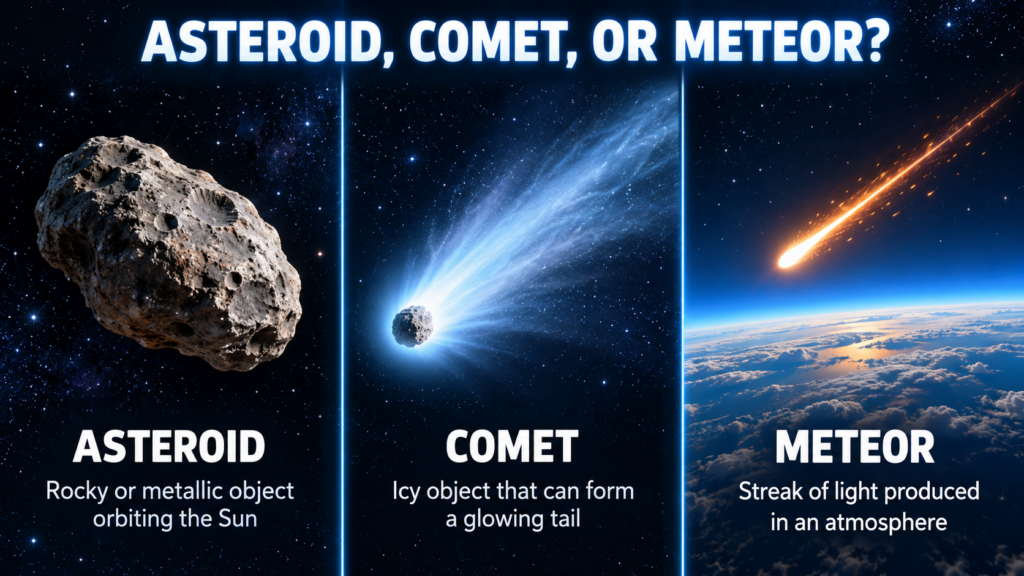
An asteroid is a rocky or metallic object orbiting the Sun. A comet is an icy, dusty object that can develop a glowing cloud and tail near the Sun. A meteor is the streak of light produced when a small space rock enters an atmosphere at high speed.
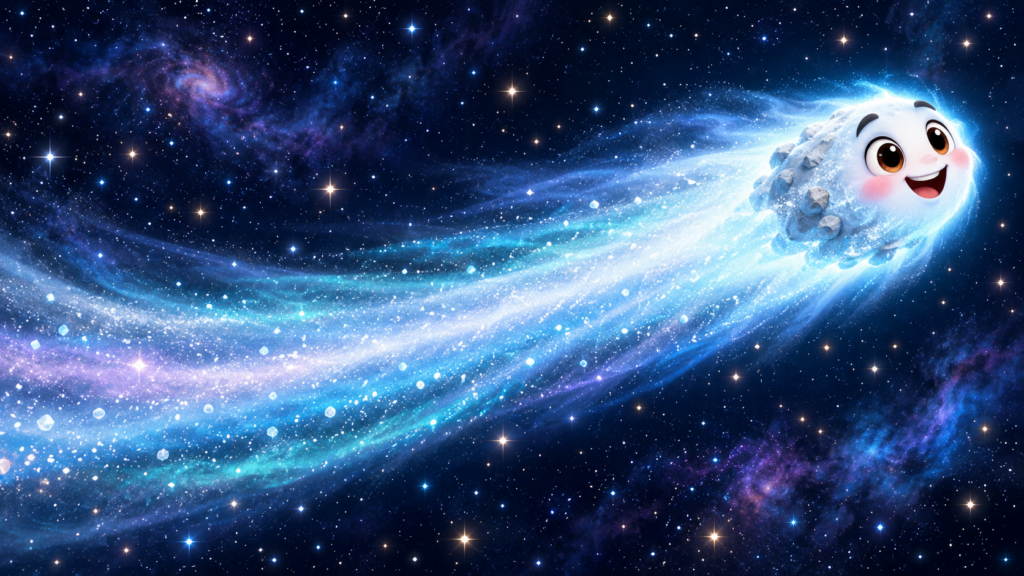
The easiest way to remember the difference is:
- Asteroid: A rocky object traveling through space
- Comet: An icy object that can develop a tail
- Meteor: A flash or streak of light in an atmosphere
Although people sometimes use these words as if they mean the same thing, each one describes something different.
What is an asteroid?
An asteroid is a rocky or metallic object that orbits the Sun. Asteroids are smaller than planets and come in many shapes and sizes.
Most known asteroids orbit in the main asteroid belt, a region between Mars and Jupiter. However, asteroids can also travel through other parts of the solar system. Some have orbits that bring them relatively close to Earth.
Asteroids are leftovers from the formation of the solar system approximately 4.6 billion years ago. Studying them can help scientists understand what materials were present when the planets were forming.
Asteroids are often irregularly shaped because many are not large enough for their gravity to pull them into spheres. They may look like enormous rocks, potatoes, or lumpy piles of rubble.
What is a comet?
A comet is an object made primarily of ice, frozen gases, dust, and rocky material. Like an asteroid, a comet orbits the Sun.
When a comet is far from the Sun, it may look like a dark, frozen object. As it approaches the Sun, its ice begins turning into gas and releasing dust. This material forms a glowing cloud around the comet’s solid center.
The comet may also develop one or more tails.
A comet’s tail does not necessarily trail behind it like hair blowing behind a runner. The solar wind and sunlight push the tail away from the Sun. This means the tail can appear beside or even in front of the comet as it travels away from the Sun.
Comets often have long, stretched-out orbits. Some return to the inner solar system regularly, while others may take hundreds or thousands of years to complete one orbit.
What is a meteor?
A meteor is not the space rock itself. It is the bright streak of light created when a small object from space enters Earth’s atmosphere at high speed.
The object pushes against and compresses the air in front of it. This produces intense heat, causing the object and surrounding air to glow. We see that glow as a fast-moving streak in the night sky.
Meteors are commonly called shooting stars, but they are not stars. Most are produced by tiny pieces of asteroids or comets.
What are meteoroids and meteorites?
The same piece of space material may receive three different names depending on where it is.
Meteoroid: still in space
A meteoroid is a relatively small piece of rock or metal moving through space. Meteoroids can be as small as grains of dust, although some are much larger.
Many meteoroids are fragments that broke away when asteroids collided. Others come from comets, planets, or moons.
Meteor: moving through an atmosphere
When a meteoroid enters Earth’s atmosphere and creates a bright streak, that visible streak is called a meteor.
Most meteoroids burn up or break apart before reaching the ground.
Meteorite: reaches the ground
If part of the object survives its trip through the atmosphere and lands on Earth, the remaining material is called a meteorite.
A simple way to remember the three terms is:
- Meteoroid: In space
- Meteor: In the atmosphere
- Meteorite: On the ground
NASA uses the object’s location to distinguish between these three names.
What causes a meteor shower?
A meteor shower occurs when Earth travels through a stream of small particles left behind by a comet or, in some cases, an asteroid.
As the particles enter Earth’s atmosphere, they create many meteors. From the ground, the streaks may appear to come from the same part of the sky.
The particles that produce most meteor showers are tiny. Some may be no larger than grains of sand.
For example, the Orionid meteor shower occurs when Earth passes through debris associated with Halley’s Comet. The comet does not need to be near Earth at the time. Its trail of particles remains spread along its orbit.
Is a comet’s tail the same as a meteor?
No. A comet and a meteor can both appear as bright objects with long shapes, but they are very different.
A comet is far away in space and may remain visible for several nights or weeks. Its tail consists of gas and dust pushed away from the comet by sunlight and the solar wind.
A meteor occurs inside an atmosphere and usually lasts only a fraction of a second or a few seconds.
If a bright streak flashes across the sky and quickly disappears, it was probably a meteor. If a fuzzy object appears in approximately the same part of the sky over several nights, it may be a comet.
Are asteroids and comets dangerous?
Most asteroids and comets remain far from Earth and present no danger.
Scientists carefully track objects whose orbits bring them relatively close to our planet. These are called near-Earth objects. Telescopes and spacecraft help scientists calculate their paths and determine whether any could pose a future risk.
Small meteoroids enter Earth’s atmosphere every day. Most are destroyed high above the ground without causing damage.
Large impacts can occur, but they are rare. Monitoring nearby objects gives scientists time to study possible threats and develop ways to protect Earth.
Children’s activity: Sort the space objects
This activity helps children learn how the same object can have a different name depending on what it is made of and where it is located.
What you will need
- Four pieces of paper
- Crayons or markers
- A small rock
- An ice cube in a sealed plastic bag
- A flashlight
- A table or floor space
Prepare the activity
Write one word on each piece of paper:
- SPACE
- ATMOSPHERE
- GROUND
- NEAR THE SUN
Place the papers in different locations.
Explore the objects
- Hold up the small rock and explain that a large rocky object orbiting the Sun could be an asteroid.
- Break off or choose a much smaller pebble. Place it on the SPACE paper. Explain that a small space rock is called a meteoroid.
- Move the pebble quickly across the ATMOSPHERE paper while shining the flashlight along its path. The light represents the bright streak called a meteor.
- Place the pebble on the GROUND paper. Explain that if it survived the trip and landed, it would be called a meteorite.
- Place the sealed ice cube on the NEAR THE SUN paper. Explain that a comet contains ice and dust. Near the Sun, some of its ice turns into gas and releases material that can form a tail.
- Ask your child to draw an asteroid, comet, meteor, meteoroid, and meteorite.
Questions to ask
- Which object is mostly rocky or metallic?
- Which object contains a large amount of ice?
- Which word describes the streak of light?
- What is a small space rock called before it enters the atmosphere?
- What is it called if a piece reaches the ground?
- Which object can grow a tail near the Sun?
Safety note: Keep the ice inside a sealed bag, use only clean ordinary rocks, and supervise young children around small objects.
Frequently asked questions
Is a meteor a falling star?
No. A meteor is a streak of light caused by space material entering an atmosphere. It has nothing to do with an actual star falling.
Can an asteroid become a meteor?
A small piece of an asteroid can break off and become a meteoroid. If that piece enters Earth’s atmosphere and produces a streak of light, we call the streak a meteor.
Can meteors come from comets?
Yes. Many meteors are produced by small pieces of dust and material left behind by comets.
Do all comets have tails?
Comets usually develop visible clouds and tails when they travel close enough to the Sun for their frozen material to warm and release gas and dust. Far from the Sun, a comet may have no visible tail.
Can a meteor land on Earth?
The meteor is the visible streak of light, so the meteor itself does not land. If part of the object survives and reaches the ground, that piece is called a meteorite.
What is the main difference between an asteroid and a comet?
Asteroids are generally made mostly of rock or metal. Comets contain substantial amounts of ice and dust. Both orbit the Sun.
Summary
Asteroids, comets, and meteors are related, but they are not the same thing.
An asteroid is a rocky or metallic object orbiting the Sun. A comet is an icy, dusty object that can form a glowing cloud and tail near the Sun. A meteor is the streak of light produced when a meteoroid enters an atmosphere.
If the object remains in space, it is a meteoroid. If a piece reaches the ground, it becomes a meteorite.
The quick answer: Asteroids are rocky worlds in space, comets are icy objects that can grow tails, and meteors are brief streaks of light in an atmosphere.