
The Moon seems to change shape because it orbits Earth, allowing us to see different amounts of the half illuminated by the Sun. The Moon itself does not change shape. The changing appearances we see are called the phases of the Moon.
At certain points in its orbit, nearly the entire sunlit half faces Earth, producing a full Moon. At other points, we see only a thin sunlit crescent—or almost none of the illuminated half at all.
Does the Moon produce its own light?
No. The Moon does not make its own light.
Moonlight is sunlight reflecting from the Moon’s surface. The Sun always illuminates half of the Moon, just as it illuminates half of Earth.
As the Moon moves around Earth, our viewing angle changes. Sometimes we see most of its illuminated half. Sometimes we see only a small part of it. The remainder of the side facing us is still there, but it is too dark to see clearly.
That changing view creates the Moon’s phases.
Is Earth’s shadow causing the phases?
No. Earth’s shadow does not normally create the phases of the Moon.
This is a common misunderstanding. The dark part of a crescent or half Moon is part of the Moon experiencing nighttime. It is not usually covered by Earth’s shadow.
Earth’s shadow falls on the Moon during a lunar eclipse. An eclipse is a separate event that does not happen every month because the Moon’s orbit is slightly tilted.
What are the eight phases of the Moon?
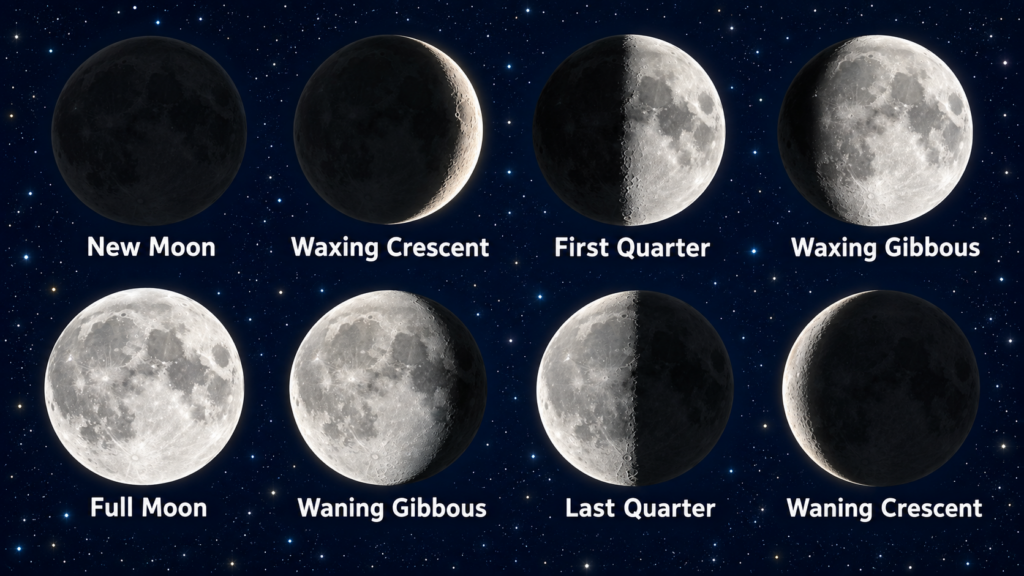
The Moon moves through eight commonly named phases:
- New Moon: The illuminated half faces mostly away from Earth, so the Moon is difficult or impossible to see.
- Waxing Crescent: A thin, curved section of the Moon becomes visible.
- First Quarter: Half of the Moon’s visible face appears illuminated.
- Waxing Gibbous: More than half appears illuminated, and the bright portion continues growing.
- Full Moon: Nearly the entire side facing Earth appears bright.
- Waning Gibbous: More than half remains illuminated, but the bright portion begins shrinking.
- Last Quarter: Half of the visible Moon appears illuminated again.
- Waning Crescent: Only a thin crescent remains before the cycle returns to the new Moon.
The word waxing means the illuminated portion appears to be growing. Waning means it appears to be shrinking. A gibbous Moon is more than half illuminated but not completely full.
How long does the Moon’s phase cycle take?
It takes approximately 29½ days for the Moon to move from one new Moon to the next. This period is sometimes called a lunar month.
The Moon looks slightly different from one night to the next because it continues moving along its orbit. The change may be difficult to notice in a single evening, but it becomes much clearer when you compare the Moon over several nights.
The cycle then repeats in the same order.
Why do we always see the same side of the Moon?
The Moon rotates, even though it may not appear to do so.
It takes the Moon about the same amount of time to rotate once as it takes to orbit Earth once. Because those two movements happen at the same rate, approximately the same side of the Moon always faces Earth.
This is called synchronous rotation or tidal locking.
The side that faces away from us is often called the “dark side,” but that name is misleading. The far side receives just as much sunlight as the near side. We simply do not normally see it from Earth.
Can the Moon be visible during the day?
Yes. The Moon can frequently be seen during daylight.
The Moon is not limited to the nighttime sky. Its position changes as it moves around Earth, so it sometimes rises during the day and sometimes during the night.
Whether you can see it depends on its phase, its position in the sky, the time of day, and the brightness of the sunlight.
Children’s activity: Make the phases of the Moon
This activity helps children see why the Moon appears to change shape.
What you will need
- A flashlight or lamp
- A small white ball
- A pencil or stick that can safely hold the ball
- A dim room
- An adult to help
What to do
- Place the flashlight or lamp in one location. It represents the Sun.
- Hold the white ball at arm’s length. The ball represents the Moon.
- Your child’s head represents Earth, and the child’s eyes show the view from Earth.
- Point the flashlight toward the ball.
- Slowly turn in a circle while keeping the ball in front of you.
- Watch how the illuminated part of the ball appears to change.
When the ball is between you and the light, its bright side faces away from you. This models a new Moon.
When the ball is on the opposite side, its illuminated face points toward you. This models a full Moon.
At positions in between, you will see crescent, quarter, and gibbous shapes.
The ball never changes shape, and the light always illuminates half of it. Only your view of the illuminated half changes.
Safety note: Use a household flashlight or lamp for the activity. Never stare directly at the Sun.
Try a month-long Moon journal
Ask your child to observe the Moon for several weeks.
Each time the Moon is visible, record:
- The date
- The time
- The Moon’s shape
- Where it appears in the sky
- Whether the illuminated portion seems to be growing or shrinking
Draw the Moon inside a circle on each journal page. After several observations, arrange the drawings by date and look for the pattern.
Cloudy nights and missed observations are fine. The goal is to notice that the Moon’s appearance changes gradually and predictably.
Frequently asked questions
Does the Moon really change shape?
No. The Moon remains round. We see different portions of its sunlit half as it travels around Earth.
Why can’t we see the new Moon?
During the new Moon phase, the illuminated side faces mostly away from Earth. The side facing us is dark, and the Moon also appears near the Sun in our sky.
Why is it called a half Moon if it is a quarter phase?
At first quarter and last quarter, half of the Moon’s visible face looks bright. The word quarter describes how far the Moon has traveled through its monthly orbit, not how much of the Moon appears illuminated.
Is a crescent Moon Earth’s shadow?
No. The dark area is the nighttime portion of the Moon. Earth’s shadow causes a lunar eclipse, not the Moon’s regular phases.
Does everyone on Earth see the same Moon phase?
Yes. People around the world see the same general phase at the same time, although the Moon’s orientation may look different from different hemispheres.
Summary
The Moon does not actually change shape. The Sun always illuminates half of it, but the Moon’s position changes as it travels around Earth. From our viewpoint, we see different amounts of that illuminated half.
These changing views create the new Moon, crescents, quarter Moons, gibbous Moons, and full Moon.
The quick answer: The Moon seems to change shape because it moves around Earth, changing how much of its sunlit half we can see.